 | "Moreover, brethren, I declare unto you the gospel... By which also ye are saved... unless ye have believed in vain. For I delivered unto you first of all that which I also received, how that Christ died for our sins according to the scriptures; And that he was buried, and that he rose again the third day according to the scriptures" (1 Corinthians 15:1-4) |
 | |
I am God, and there is none like me . . . (Isaiah 46:9)
(Part 1)FOREWORD
"Remember the former things of old: for I am God, and there is none else; I am God, and there is none like me, Declaring the end from the beginning, and from ancient times the things that are not yet done, saying, My counsel shall stand, and I will do all my pleasure . . . I have spoken it, I will also bring it to pass; I have purposed it, I will also do it" (Isaiah 46:9-11).
Our God is a consuming fire, even a jealous God. He is God of gods, and Lord of lords, a great God, a mighty, and a terrible, which regardeth not persons, nor taketh reward. He is mighty in strength and wisdom. He is Holy and Just. He is righteous and true. He is faithful. He is One. He is Light. He is Love. God is good. He is a merciful God. He is the Creator. He is Eternal. He is Omnipotent, and Omnipresent, and also Omniscient.
These are some of the characteristics, or attributes of God. If one desire to know more of Him with whom we have to do, we can search out each one of these attributes in the word of God. We are told that "God, who at sundry times and in divers manners spake in time past unto the fathers by the prophets, Hath in these last days spoken unto us by his Son" (Heb 1:1-2). God has used various people and modes to speak to us, but the final revelation of God to mankind is His Son. The Bible tells us that the Lord Jesus Christ is "the brightness of his glory, and the express image of his person." If we want to know God, to the ultimate extent that we might know Him, we should look to His Son. We all have limited knowledge of Him today, but we can grow in the grace and knowledge of Him through study of His Word. The apostle Paul would say, "That I may know him, and the power of his resurrection, and the fellowship of his sufferings, being made conformable unto his death" (Philip. 3:10).
Can we know God and His Son? The apostle John would say, "And we know that the Son of God is come, and hath given us an understanding, that we may know him that is true, and we are in him that is true, even in his Son Jesus Christ. This is the true God, and eternal life" (1John 5:20).
How important is it to know God and His Son? It is more important as life itself. Jesus said, "And this is life eternal, that they might know thee the only true God, and Jesus Christ whom thou hast sent" (John 17:3). Eternal life comes through knowledge of God and His Son, "Who will have all men to be saved, and to come unto the knowledge of the truth" (1Tim 2:4), so it is clear to see that it is a worthwhile endeavor to seek God while he is near for our life is but a vapor of smoke, and a leaf that fades away. To consume ones life with the pleasures of this world will most assuredly result not only in our own disappointment but perhaps the loss of our own soul. To the contrary, looking to God results in hope, and a life worth living for the Saviour. "Looking unto Jesus the author and finisher of our faith" (Heb. 12:2).
When we look to the word of God we get to find out more about his character. We find that He is a consuming fire, and a jealous God who hates sin. We see how he has destroyed the wicked and judged His own people Israel for their transgressions. We are told that "The fear of God is the beginning of wisdom: and the knowledge of the holy is understanding" (Prov. 9:10). Knowledge of God brings responsibility. We have all been given free moral agency and a will to choose between good and evil. The nation Israel was promised great blessing if they would hearken unto God, but to the contrary, if they would turn away from God and his commandments, they would be dealt with in judgment. Therefore, the Bible tells us "we ought to give the more earnest heed to the things which we have heard, lest at any time we should let them slip" (Heb. 2:1). And again, "See that ye refuse not him that speaketh. For if they escaped not who refused him that spake on earth, much more shall not we escape, if we turn away from him that speaketh from heaven" (Heb. 12:25).
The Bible tells us that "it is a fearful thing to fall into the hands of the living God" (Heb. 10:31). Do you fear God? We are told to "fear not them which kill the body, but are not able to kill the soul: but rather fear him which is able to destroy both soul and body in hell" (Mt. 10:28). The Bible tells us that "The wicked shall be turned into hell, and all the nations that forget God" (Ps. 9:17). The fear of God is the beginning of wisdom. You can run from God, but you can not hide. He will find you out. He knows everything about you.
My friend, if you are found with sin, He will cast you out of His sight into the pit of Hell, that lake of fire that burneth with fire and brimstone, where the smoke of your torment will ascend up forever and ever. The Bible tells us "Thou art of purer eyes than to behold evil, and canst not look on iniquity" (Hab. 1:13). "This then is the message which we have heard of him, and declare unto you, that God is light, and in him is no darkness at all" (1John 1:5). My friend, God is Light. He is a Holy God. He is without sin. His Ten Commandments show forth His moral character. He is Holy and upright, undefiled, pure, perfect, and separate from sinners.
When we find such knowledge of God, perhaps certain questions come to mind such as, How may we come up to such an One who is so High and Holy? Why should he care for me? Why does he not send fire down from heaven now to consume me and be done with it? Why does he not now open up the earth and swallow me up and cast me out of His sight forever? I certainly cannot, nor ever will measure up to His perfect Holiness. I am weak and defiled with sin and laden with iniquity. Why has he not yet forsaken me, for I have heard another voice crying "My God, My God, why hast thou forsaken me?"
Is He not Love? We are told in the Bible that "The Heavens declare the Glory of God and the firmament sheweth his handywork" (Psalm 19:1). They speak of His might and strength and his Majesty, especially when we learn that by the word of His mouth he spake it into being. "For the invisible things of him from the creation of the world are clearly seen, being understood by the things that are made, even his eternal power and Godhead; so that they are without excuse" (Romans 1:20). Mankind is without excuse when he turns away from or denies God. It is the fool who has said in his heart there is no God. By the witness of creation alone, mankind is without excuse. By looking to the heavens we can learn of his eternal power, but if we are to learn of His love and His mercy and His grace, we will not find it by looking unto the heavens, but to the one who has created all things, God's own Son, the well beloved, Jesus Christ.
"For God so loved the world, that he gave his only begotten Son, that whosoever believeth in him should not perish, but have everlasting life. For God sent not his Son into the world to condemn the world; but that the world through him might be saved. He that believeth on him is not condemned: but he that believeth not is condemned already, because he hath not believed in the name of the only begotten Son of God. And this is the condemnation, that light is come into the world, and men loved darkness rather than light, because their deeds were evil. For every one that doeth evil hateth the light, neither cometh to the light, lest his deeds should be reproved. But he that doeth truth cometh to the light, that his deeds may be made manifest, that they are wrought in God" (John 3:16-21). It is sad to say that most of the world today is on that broad road that leads to destruction, and will not come to God's Son, "the true Light, which lighteth every man" , who alone is the narrow way to the Father. They are for the most part trying to come up some other way, offering up their own goodness in exchange for their ticket to heaven, saying 'I am not that bad'. We are told "There is a generation that are pure in their own eyes, and yet is not washed from their filthiness" (Prov. 30:12). The Bible tells us "The sacrifice of the wicked is abomination: how much more, when he bringeth it with a wicked mind?" (Prov. 21:27) Nothing that mankind can offer will appease the wrath of God against sin. Jesus Christ would tell the self-righteous, "But go ye and learn what that meaneth, I will have mercy, and not sacrifice: for I am not come to call the righteous, but sinners to repentance" (Mt. 9:13). He said "They that be whole need not a physician, but they that are sick" (v. 12).
The whole of Mankind is sick "from the sole of the foot even unto the head" (Isaiah 1:4-6). Mankind's offering will not buy a cure. The offering of mans hand is a stench in the nostrils of God, much in the same way that the preaching of the cross is to them that are perishing foolishness. The offering of Cain's hand was not accepted. For "unto Cain and to his offering he had not respect" (Gen. 4:5). But the Lord told him "If thou doest well, shalt thou not be accepted?" (v. 7) Mankind's offerings for sin will never be accepted by the most High God, but rather, he desires to show mercy. "For I desire mercy, and not sacrifice; and the knowledge of God more than burnt offerings" (Hosea 6:6). He desires for mankind to know Him, to see that He desires to forgive their iniquities, but on His own terms. A God who is "ready to pardon, gracious and merciful, slow to anger, and of great kindness". (Neh. 9:17) He is "plenteous in mercy" (Psalm 103:8), and "full of compassion" (Psalm 145:8). "There is forgiveness with thee, that thou mayest be feared" (Psalm 130:4).
During the Feast of Tabernacles, Israel was required under the law to bring a multitude of animals (198) to offer up in sacrifice (Numb. 29:13-38), which did not include the continual burnt offering, his meat offering, and his drink offering. This feast lasted eight days. "In the last day, that great day of the feast, Jesus stood and cried, saying, If any man thirst, let him come unto me, and drink. He that believeth on me, as the scripture hath said, out of his belly shall flow rivers of living water" (John 7:37-38). As Jesus looked upon this nation, bringing their multitude of sacrifices, in slavish servitude to the Law, and in religious bondage, He desired to gather them under His wing, as a hen gathers her chicks. In compassion would cry, "Come unto Me" , Look unto Me, Turn away from your offerings and look upon me, the true Lamb of God that bears away the sin of the world, the only one who can redeem you from your slavery to sin, the only one who can cleanse you from all unrighteousness.
The nation Israel, as today, was going about to establish their own righteousness. Their hearts had turned away from God to their own doing. They thought that they would be accepted for the multitude of their offerings. Was this not what God required under the Law? Would not their multitude of burnt offerings make them acceptable to God? No!
"For it is not possible that the blood of bulls and of goats should take away sins. Wherefore when he cometh into the world, he saith, Sacrifice and offering thou wouldest not, but a body hast thou prepared me: In burnt offerings and sacrifices for sin thou hast had no pleasure. Then said I, Lo, I come (in the volume of the book it is written of me,) to do thy will, O God. Above when he said, Sacrifice and offering and burnt offerings and offering for sin thou wouldest not, neither hadst pleasure therein; which are offered by the law; Then said he, Lo, I come to do thy will, O God. He taketh away the first, that he may establish the second. By the which will we are sanctified through the offering of the body of Jesus Christ once for all. And every priest standeth daily ministering and offering oftentimes the same sacrifices, which can never take away sins: But this man, after he had offered one sacrifice for sins for ever, sat down on the right hand of God" (Heb. 10:4-12).
Christ "hath given himself for us as an offering and a sacrifice to God for a sweet-smelling savour" (Eph. 5:2). "By one offering he hath perfected for ever them that are sanctified. . . Now where forgiveness of these is, there is no more offering for sin" (Heb. 10:14, 18). "It is Finished" (John 19:30) was his cry. The great work of salvation was accomplished on Calvary's cross, and the debt for sin was paid in full. "By his own blood he entered in once into the holy place, having obtained eternal redemption for us" (Heb. 9:12). Having finished the work of our redemption, He sat down on the right hand of God. "Jesus paid it all, all to Him I owe, sin had left a crimson stain, He washed it white as snow." Hallelujah, what a Saviour.
Are you yet a stranger to God's grace? The Bible tells us "Being justified freely by his grace through the redemption that is in Christ Jesus: Whom God hath set forth to be a propitiation through faith in his blood, to declare his righteousness for the forgiveness of sins" (Romans 3:24-25). Jesus is calling "Come unto me, all ye that labour and are heavy laden, and I will give you rest" (Mt. 11:28). Perhaps you have been working very hard to be accepted of God, but the only way to God is through His Son. We will only be accepted through the one offering of Christ on our behalf, which alone is of eternal value. Will you accept His offering on your behalf? Will you trust Him? Will you take that step of faith and come to Him and rest from your labors? We are encouraged to "come boldly unto the throne of grace, that we may obtain mercy, and find grace to help in time of need" (Heb. 4:16). Are you not tired of your religious exercises? Only the blood of Christ can "purge your conscience from [these] dead works" (Heb. 9:14), that you might serve the living God. "Christ died for our sins according to the scriptures; and he was buried, and he rose again the third day according to the scriptures" (1Cor. 15:3). He has "put away sin by the sacrifice of himself" (Heb. 9:26), and His offering alone on our behalf was acceptable to God. He is the One Mediator between God and Man. If any try to come up another way, their sin will find them out, and they will be cast out. If one has not on the righteousness which is of God, these will be the words to him, "Bind him hand and foot, and take him away, and cast him into outer darkness; there shall be weeping and gnashing of teeth" (Mt. 22:13).
"For we ourselves also were sometimes foolish, disobedient, deceived, serving divers lusts and pleasures, living in malice and envy, hateful, and hating one another. But after that the kindness and love of God our Saviour toward man appeared, Not by works of righteousness which we have done, but according to his mercy he saved us, by the washing of regeneration, and renewing of the Holy Ghost; Which he shed on us abundantly through Jesus Christ our Saviour; That being justified by his grace, we should be made heirs according to the hope of eternal life" (Titus 3:3-7).
The prophets of old who came nigh unto God, who stepped into the light of His glory found it hard with human words to express the likeness of God, for they could find nothing or no one with whom they could compare Him to. They knew for certain that He was not like them in His thoughts and ways, and they in His presence were made abase with the counsel and deeds of His personage. When God mightily saved Israel from the destruction of Pharaoh with mighty signs and wonders, Moses would say, "Who is like unto thee, O LORD, among the gods? who is like thee, glorious in holiness, fearful in praises, doing wonders?" (Exodus 15:11) In the end of Moses days he would say, "O Lord GOD, thou hast begun to shew thy servant thy greatness, and thy mighty hand: for what God is there in heaven or in earth, that can do according to thy works, and according to thy might?" (Deut 3:24) David would say, "Thy righteousness also, O God, is very high, who hast done great things: O God, who is like unto thee!" (Psalm 71:19) "Among the gods there is none like unto thee, O Lord; neither are there any works like unto thy works" (Psalm 86:8). The prophet Jeremiah would wonder in awe with the One whom he came to know. "Forasmuch as there is none like unto thee, O LORD; thou art great, and thy name is great in might. Who would not fear thee, O King of nations? for to thee doth it appertain: forasmuch as among all the wise men of the nations, and in all their kingdoms, there is none like unto thee" (Jer. 10:6-7). Micah would say, "Who is a God like unto thee, that pardoneth iniquity, and passeth by the transgression of the remnant of his heritage? he retaineth not his anger for ever, because he delighteth in mercy" (Micah 7:18) Such is a sample of the words of those who would get a glimpse of the glory of God, and of His salvation and deliverance. They would have to agree with the words of God Himself, "There is none like me" .
G.N.C.
Introduction
One of the most amazing characteristics of God, from the human point of view is
His Omniscience. He is the Alpha and
Omega, the beginning and the ending, and everything in between. He knows
everything about you and me before we were
born, even before the world was. He is the One which was, and is, and is to
come, the Almighty, and He knows everything that
is going to happen before it comes to pass.
"Behold, the former things are come to pass, and new things do I declare: before
they spring forth I tell you of them"
(Isaiah 42:9). Only God can know the future and what the day will bring. Man,
to the
contrary, is told
"Boast not thyself of to morrow; for thou knowest not what a day may bring
forth"
(Prov. 27:1).
God puts forth the challenge to all false prophets and religions saying, "Produce your cause, saith the LORD; bring forth your strong reasons, saith the King of Jacob. Let them bring them forth, and shew us what shall happen: let them shew the former things, what they be, that we may consider them, and know the latter end of them; or declare us things for to come. Shew the things that are to come hereafter, that we may know that ye are gods" (Isaiah 41:21-23). Accurate prophecy belongs to the Lord alone. He alone knows the end from the beginning. The precision of fulfilled prophecy is an irrefutable proof of God's foreknowledge and sovereignty. It undeniably proves that the Bible is the Revelation of God's truth. It is His Story from His perspective, regarding the fall of man and his separation from God, but also his restoration and pardon made possible through Jesus Christ His Son.
Should we spend our time studying the prophetic portions of Scripture? Well, the Bible tells us that "All scripture is given by inspiration of God, and is profitable" (2Tim. 3:16). The study of any portion of scripture is profitable for the man of God, but the apostle Peter is more direct in answering this question. He says that "We have also a more sure word of prophecy; whereunto ye do well that ye take heed, as unto a light that shineth in a dark place, until the day dawn, and the day star arise in your hearts: Knowing this first, that no prophecy of the scripture is of any private interpretation. For the prophecy came not in old time by the will of man: but holy men of God spake as they were moved by the Holy Ghost" (2Peter 1:19-21).
Fulfilled prophecy strengthens our confidence in the word of God. It assures us that the balance of the prophetic word will be fulfilled with the same precision and accuracy. The prophetic word gives us hope that the Lord is coming again. "And every man that hath this hope in him purifieth himself, even as he is pure" (1John 3:3). The prophetic word also gives us incentive for Holy Living. It would do us well to take heed to what God has said, for His word is true and his testimony is amen.
There are prophecies in regards to nations, in particular, the nation Israel. There are also prophecies concerning individuals, but most of all, the coming Messiah, the redeemer and Saviour of the world, the Lord Jesus Christ. There needs to be discernment in regards to the coming of the Messiah, for he comes to the earth not once, but twice. Concerning Christ's first coming, there are over 300 prophecies. [See Appendix A] When Christ first came 2000 years ago, he told the Pharisees to, "Search the scriptures; for in them ye think ye have eternal life: and they are they which testify of me" (John 5:39). The Old Testament was full of prophecies concerning the coming Messiah, that they should have no excuse for not knowing the "time of their visitation" .
Likewise there are many prophecies surrounding his second coming. Christ told his disciples that he was going to be leaving them, but did not leave them in despair. He told them "Let not your heart be troubled...I will come again" (John 14:1-3). The disciples later came to him on the Mount of Olives and asked him the question, "what shall be the sign of thy coming, and of the end of the world?" (Mt. 24:3) Or literally, the end of the age. Christ then told them of many signs which would precede his second coming.
In the Old Testament as well as the New we hear of the last days, the latter times, or the time of the end, which would characterize the end of the age before Christ returns. We should examine these and ask ourselves, Do these have any relevance for the day in the midst of which we live?
Another point could be made that we do not confuse the Second coming with the rapture. The second coming of Christ is to the earth to redeem Israel. The rapture is the catching away of the body of Christ to meet the Lord in the air. The rapture is imminent, that is, it could happen at any moment without any signs or warning. The second coming is preceded by signs that would indicate that His coming is near. The early church was not looking for signs but for "that blessed hope, and the glorious appearing of the great God and our Saviour Jesus Christ" (Titus 2:13), The scriptures indicate that the rapture precedes the second coming by at least seven years. Now, although we do not know the "day or the hour" of the appearing of our Saviour, the Bible tells us that we may know that his second coming "is near, even at the doors".
Although the rapture is imminent, when we see the signs foretold by God of the second coming that a generation would witness, we would have to leave open the possibility that the rapture may be nearer than we think.
There were over three hundred prophecies concerning the first coming of Christ that would help the people recognize that the "kingdom of heaven is at hand" (Mt. 4:17). Likewise, we are foretold of many signposts that would indicate once again that "the kingdom of God is nigh at hand" (Luke 21:31). When Christ came the first time he would say "many prophets and righteous men have desired to see those things which ye see, and have not seen them; and to hear those things which ye hear, and have not heard them" (Matthew 13:17). The salvation which "the prophets have enquired and searched diligently" for had come, but sad to say the people's heart was waxed gross, and their ears were dull of hearing and their eyes were darkened. They did not comprehend the Light.
Jesus told the Pharisees, "Did ye never read in the scriptures, The stone which the builders rejected, the same is become the head of the corner: this is the Lord's doing, and it is marvelous in our eyes?" (Matthew 21:42) Something marvelous was happening right before their very eyes but they were not looking. They did not recognize what the prophets had foretold and their eyes were blind to His salvation.
On another occasion "The Pharisees also with the Sadducees came, and tempting desired him that he would shew them a sign from heaven. He answered and said unto them, When it is evening, ye say, It will be fair weather: for the sky is red. And in the morning, It will be foul weather to day: for the sky is red and lowering. O ye hypocrites, ye can discern the face of the sky; but can ye not discern the signs of the times?" (Matthew 16:1-3)
Today we have many weather forecasters, looking to see what tomorrow will bring. It seems that in the days of Christ that the Pharisees were great forecasters of the weather. In the world today we have not only weather forecasters, we have economic forecasters, we have stock market analyzers. There are people plotting trends on just about everything you can think of, trying to figure out the direction were heading and how fast we will get there. So many issues to distract us from the real things that matter. In Christ's day there were many signs that were being fulfilled, and the Pharisees seemed to be busying themselves with discerning the weather rather than the signs of the times. Are there any signs in our times that we need to be discerning?
Judgment was pronounced on Jerusalem because her inhabitants " knewest not the time of thy visitation" (Luke 19:44). Jesus asked his disciples "Whom do men say that I the Son of man Am? And they said, Some say that thou art John the Baptist; some, Elias; and others, Jeremias, or one of the prophets" (Mt. 16:13-14). This was the sad answer of the nation Israel. God left His throne in the glory and came down to earth. God manifest in the flesh. He came down to our level but they were not looking for him, and they recieved Him not. "From that time forth began Jesus to shew unto his disciples, how that he must go unto Jerusalem, and suffer many things of the elders and chief priests and scribes, and be killed, and be raised again the third day" (Mt. 16:20). Christ foretold of many things before they were come to pass. John was told in the book of the Revelation that "the testimony of Jesus is the spirit of prophecy" (Rev. 19:10). He would tell his disciples "Now I tell you before it come, that, when it is come to pass, ye may believe that I am he" (John 13:19).
Even after telling His disciples beforehand all that must come to pass regarding him, he still had to rebuke the two on the road to Emmaus after his resurrection. "Then he said unto them, O fools, and slow of heart to believe all that the prophets have spoken" (Luke 24:25). And when he appeared to the eleven they were terrified and thought they had seen a spirit, but when they knew it was Him, He spoke to them saying, "These are the words which I spake unto you, while I was yet with you, that all things must be fulfilled, which are written in the law of Moses, and in the prophets, and in the psalms concerning me. Then opened he their understanding, that they might understand the scriptures, And said unto them, Thus it is written, and thus it behoved Christ to suffer, and to rise from the dead the third day: And that repentance and remission of sins should be preached in his name among all nations, beginning at Jerusalem" (Luke 24:44-47).
Jesus told them that all things must be fulfilled which were foretold in the word of God. Christ then ascended up into heaven, but they had that wonderful promise that He would come again, which was affirmed to them by two men dressed in white apparel saying "this same Jesus which is taken up from you into heaven, shall so come in like manner as ye have seen him go into heaven" (Acts 1:11).
The words "Christ will come again" is in many of the ancient creeds, and recited by multitudes every Sunday, but, I wonder if they, like the two on the road to Emmaus have become slow of heart to believe all that the prophets did say should come? Peter tells us "that there shall come in the last days scoffers . . . saying, Where is the promise of his coming?" (2Peter 3:3-4) But we are encouraged to "add to your faith . . . patience" , for "The Lord is not slack concerning his promise, as some men count slackness; but is longsuffering to us-ward, not willing that any should perish, but that all should come to repentance. . . And account that the long-sufferning of our Lord is salvation" (2Peter 3:9, 15).
Christ will come again, that is for sure. Christ knows them that are his, and he is awaiting till that final one says that wonderful yes to him. Perhaps it is you whom the Lord is so patiently waiting for. Perhaps your neighbor is yet to hear the gospel of Christ and be saved. Perhaps the Lord is waiting on you to finish that great commission. But until he comes we are many times over exhorted to be watching for him.
"Watch therefore: for ye know not what hour your Lord doth come" (Matthew 24:42). And may I say, it is impossible to be watching for something that you know is going to happen exactly one week from today, for the previous six days you would have no need to watch. There are no signs for the rapture, but there are signs for the second coming. Even if we do see things "begin to come to pass" we still do not know the "day or the hour" but what we may know is that "it is near, even at the doors" .
I believe that we are a most blessed generation and are indeed witnessing signs that indicate that the kingdom of our Lord Jesus is nigh at hand. The Bible tells us that we can see the day approaching, and when we do, we should not forsake the gathering of ourselves together that we might exhort one another. (Hebrews 10:25)
How desperately we need today men like the children of Issachar "that had understanding of the times" (1Chr. 12:32). They knew that it was time to "turn the kingdom" to David, "according to the word of the LORD" (1Chr. 12:23) God had given them a Benjamite, Saul, for a king, whom they chose, but now David had been anointed, whom God had chosen, and it was time to give "the scepter" to Judah, according to the prophecy of their father Jacob. (Gen. 49:10) When Christ ascended to heaven he told the apostles "It is not for you to know the times or the seasons" (Acts 1:7), for it was more important for them to be a witness for Him "unto the uttermost part of the earth" (v. 8).
Nevertheless, He would return some generation, and that generation would be expected when they "see all these things" to "know that it is near, even at the doors" (Mt. 24:33). They could understand the signs, and even though they would not attempt to guess a date, they could "look up, . . . for your redemption draweth nigh" (Luke 21:28), when they would see "these things begin to come to pass."
The signs are everywhere, yet few seem to understand the real meaning of these times. Christ is coming again, and indeed, he has given us many signs to alert us when it is near. He would liken his coming to summer. He would say "Now learn a parable of the fig tree; When her branch is yet tender, and putteth forth leaves, ye know that summer is near: So ye in like manner, when ye shall see these things come to pass, know that it is nigh, even at the doors. Verily I say unto you, that this generation shall not pass, till all these things be done" (Mark 13:28-30).
The command is to know when His coming is near! Just as when the fig tree begins to produce leaves, we can know summer is near, likewise, now that we see so many signs being fulfilled, we can know that he is coming soon. But he goes on to warn "But of that day and that hour knoweth no man, no, not the angels which are in heaven, neither the Son, but the Father. Take ye heed, watch and pray: for ye know not when the time is. For the Son of man is as a man taking a far journey, who left his house, and gave authority to his servants, and to every man his work, and commanded the porter to watch. Watch ye therefore: for ye know not when the master of the house cometh, at even, or at midnight, or at the cockcrowing, or in the morning: Lest coming suddenly he find you sleeping. And what I say unto you I say unto all, Watch" (Mark 13:32-37). Christ is "even at the doors!"
Just as all the prophecies surrounding the first coming of Christ were fulfilled with extreme accuracy [see Appendix A], so we can have the utmost assurance that God will bring to fulfillment the balance of the prophetic word with the same accuracy. There are many prophecies regarding the last days in which we could look at, but we will take this time to look at one, then examine the world in the light of the word of God to see if the stage being set for the return of the Lord.
The Revived Roman Empire
In what has to be one of the most astounding prophetic books of the Old
Testament, which we might call the Apocalypse of the
Old Testament, the prophet Daniel was given some of the most amazing prophecies
concerning the coming Messiah and the
end of the age. He was foretold the exact date of the coming of the Messiah the
first time, when He was
"cut off, but not for
himself"
(Daniel 9:26). He was also told of four successive world empires which would
exist, with the
last being revived and existing when the
Messiah comes again to set up His kingdom.
Nebuchadnezzar, king of Babylon was given a dream, and he sought out Daniel to give the interpretation thereof. Not only did he want the interpretation, but the dream itself, for Nebuchadnezzar had forgotten his dream. The wise men, the astrologers, the magicians, and the soothsayers of the kings court were first called upon to give the dream and the interpretation, but they were found out to be a bunch of charlatans. They had to admit "there is none other that can shew it before the king, except the gods, whose dwelling is not with flesh" (Dan. 2:11).
In effect they said they had no contact with the God of Heaven. So Nebuchadnezzar commanded that all the wise men of Babylon be destroyed. But Daniel petitioned the king that he might give him time, and that he would show the king the interpretation. What did Daniel do? He sought out the Lord God in prayer with his three friends, and desired mercies of the God of heaven concerning this secret, and God revealed to Daniel the Kings matter in a vision. He told king Nebuchadnezzar that "there is a God in heaven that revealeth secrets, and maketh known to the king Nebuchadnezzar what shall be in the latter days" (Dan. 2:28).
The Bible tells us "The secret things belong unto the LORD our God: but those things which are revealed belong unto us and to our children for ever" (Deut. 29:29). We are told "But as it is written, Eye hath not seen, nor ear heard, neither have entered into the heart of man, the things which God hath prepared for them that love him. But God hath revealed them unto us by his Spirit: for the Spirit searcheth all things, yea, the deep things of God" (1Cor. 2:9-10). God is the revealer of secrets, and don't you forget it, apart from the revelation of God we know nothing.
Daniel's testimony was, God "made me know the interpretation of the things" (Dan. 7:16). Daniel did not take any glory for himself saying, "But as for me, this secret is not revealed to me for any wisdom that I have more than any living" , but he would make known to the Babylonian king that there is a God in heaven that "revealeth the deep and secret things" , and who "giveth wisdom unto the wise and knowledge to them that know understanding" (Dan. 2:21-22). The apostle Paul would tell the young Timothy, "Consider what I say; and the Lord give thee understanding in all things" (2Tim 2:7). If God does not give the understanding, let me tell you, it is all guesswork which leads to confusion. Without the revelation of God we are lost.
So Daniel begins by telling the king his dream. "Thou, O king, sawest, and behold a great image. This great image, whose brightness was excellent, stood before thee; and the form thereof was terrible. This image's head was of fine gold, his breast and his arms of silver, his belly and his thighs of brass, His legs of iron, his feet part of iron and part of clay. Thou sawest till that a stone was cut out without hands, which smote the image upon his feet that were of iron and clay, and brake them to pieces. Then was the iron, the clay, the brass, the silver, and the gold, broken to pieces together, and became like the chaff of the summer threshingfloors; and the wind carried them away, that no place was found for them: and the stone that smote the image became a great mountain, and filled the whole earth" (Dan. 2:31-35).
The dream was of a great multi-metalic image and of its destruction by "a stone, cut out without hands" . Daniel said, "This is the dream; and we will tell the interpretation thereof before the king." Now Daniel proceeds to tell him what the dream signifies.
"Thou, O king, art a king of kings: for the God of heaven hath given thee a kingdom, power, and strength, and glory. And wheresoever the children of men dwell, the beasts of the field and the fowls of the heaven hath he given into thine hand, and hath made thee ruler over them all. Thou art this head of gold. And after thee shall arise another kingdom inferior to thee, and another third kingdom of brass, which shall bear rule over all the earth. And the fourth kingdom shall be strong as iron: forasmuch as iron breaketh in pieces and subdueth all things: and as iron that breaketh all these, shall it break in pieces and bruise. And whereas thou sawest the feet and toes, part of potters' clay, and part of iron, the kingdom shall be divided; but there shall be in it of the strength of the iron, forasmuch as thou sawest the iron mixed with miry clay. And as the toes of the feet were part of iron, and part of clay, so the kingdom shall be partly strong, and partly broken. And whereas thou sawest iron mixed with miry clay, they shall mingle themselves with the seed of men: but they shall not cleave one to another, even as iron is not mixed with clay. And in the days of these kings shall the God of heaven set up a kingdom, which shall never be destroyed: and the kingdom shall not be left to other people, but it shall break in pieces and consume all these kingdoms, and it shall stand for ever. Forasmuch as thou sawest that the stone was cut out of the mountain without hands, and that it brake in pieces the iron, the brass, the clay, the silver, and the gold; the great God hath made known to the king what shall come to pass hereafter: and the dream is certain, and the interpretation thereof sure" (Dan. 2:37-45).
Here we have Daniel's interpretation, and the history of the world as far as God is concerned. There will be four successive world kingdoms that will embrace the world, and they will be destroyed and replaced with the kingdom of God.
The first of these kingdoms was the Babylonian kingdom to which Nebuchadnezzar was king. He was a world ruler, a dictator, and God had given him a kingdom signified by the head of gold. The prophet Jeremiah said, "I have made the earth, the man and the beast that are upon the ground, by my great power and by my outstretched arm, and have given it unto whom it seemed meet unto me. And now have I given all these lands into the hand of Nebuchadnezzar the king of Babylon, my servant; and the beasts of the field have I given him also to serve him. And all nations shall serve him, and his son, and his son's son, until the very time of his land come: and then many nations and great kings shall serve themselves of him" (Jeremiah 27:5-7).
The next kingdom to arise after the Babylonian kingdom was to be "inferior", and was signified by the breast and arms of silver of the great image. There is no need for speculation as to what kingdom this was, for the scriptures are clear as to what happened to the Babylonian kingdom. The Babylonian kingdom was conquered by the Medo-Persian kingdom under the leadership of Darius the Median. "Thy kingdom is divided, and given to the Medes and Persians" (Dan 5:28) (7:5, 8:3-4, 20, 6:28, 11:1-2).
The next kingdom to arise after the Medo-Persian empire was to "bear rule over all the earth" , and was signified by the "belly and thighs of brass" . This was the Grecian empire under Alexander the Great (7:6, 8:5-8, 21-23, 10:20, 11:2-4).
The next kingdom to arise after the Grecian empire was the Roman empire signified by the "legs of iron, his feet part of iron and clay." This is the kingdom that is given the most attention to in the scripture. It is this kingdom that we will examine in this portion, for it is "in the days of these kings" (ten toes, v. 42) that the God of heaven shall "set up a kingdom, which shall never be destroyed" .
This is the kingdom that existed at the time of our Messiah's first coming. It was the empire under whose reign Jesus Christ was crucified. It will also be the empire that exists when He comes again in great glory to set up His kingdom, and rule over the earth. The kingdoms of this world. "He shall have dominion also from sea to sea, and from the river unto the ends of the earth" (Psalm 72:8).
Now, this may be further established by the following. We are told that "the people of the prince that shall come shall destroy the city and the sanctuary; and the end thereof shall be with a flood, and unto the end of the war desolations are determined" (Dan. 9:26). It was the people of the Roman empire who destroyed Jerusalem and the sanctuary in AD 70 under the Roman general Titus. This same people are said to be the people of the "prince that shall come", that is Antichrist, who will be the world ruler when Christ comes again. The Antichrist "shall confirm the covenant with many for one week: [Daniel's 70th Week, 9:24] and in the midst of the week he shall cause the sacrifice and the oblation to cease, and for the overspreading of abominations he shall make it desolate, even until the consummation, and that determined shall be poured upon the desolate" (Dan. 9:27).
Now, we were also told that the "the kingdom shall be divided" (2:41), and that it "shall be partly strong, and partly broken" (2:42). The Roman empire was divided between east and west, Constantinople in the east and Rome in the west, signified by the two legs in Daniel's vision. The final form of this kingdom will be further divided into ten regions with ten kings signified by the ten toes. These ten kings will then give their kingdom over to one king, the "little horn" of Daniel, that man of sin, the Antichrist. "And the ten horns out of this kingdom are ten kings that shall arise: and another shall rise after them; and he shall be diverse from the first" (Dan. 7:24), and shall reign for three and one half years (v. 25), the latter half of Daniel's 70th Week.
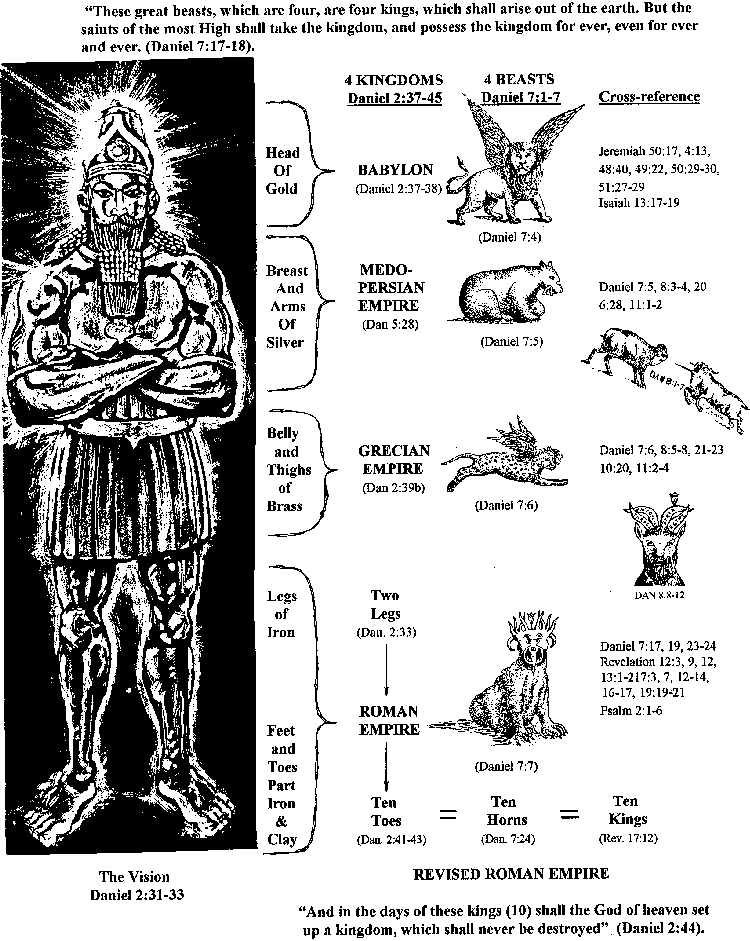
Four Beasts
Daniel was given another vision in chapter seven of these four kingdoms, but
this time they were represented by four wild
beasts.
"And four great beasts came up from the sea, diverse one from another. The
first was like a lion, and had eagle's wings:
I beheld till the wings thereof were plucked, and it was lifted up from the
earth, and made stand upon the feet as a man, and a
man's heart was given to it"
(v. 3-4). The kingdom of Babylon was now represented by a lion with eagles
wings which
corresponds to the head of gold in Nebuchadnezzar's image. This spoke of the
strength and swiftness of the Babylonians (Jer.
50:17, 4:13, 48:40, 49:22). But in the end its wings were plucked (Jer.
50:29-30).
"And behold another beast, a second, like to a bear, and it raised up itself on one side, and it had three ribs in the mouth of it between the teeth of it: and they said thus unto it, Arise, devour much flesh" (v.5). This signified the Medo-Persian empire which answers to the breast and arms of Neb's image. They "took the kingdom" from Belshazzar, the grandson of Nebuchadnezzar (Isaiah 13:17-19, Jer. 51:27-29). Darius the Mede and Cyrus the Persian were the principle kings of this empire with Cyrus the king of Persia rising to predominance. The three sections of the Babylonian empire they did take, with Babylon in the east, Egypt to the south, and Lydia in Asia Minor to the North which answers to Daniel 8:4.
"After this I beheld, and lo another, like a leopard, which had upon the back of it four wings of a fowl; the beast had also four heads; and dominion was given to it" (v. 6). This signified the Grecian empire of Alexander the great, whose empire was divided between four generals at his death. This answers to the belly and thighs of brass of Nebuchadnezzar's image.
"After this I saw in the night visions, and behold a fourth beast, dreadful and terrible, and strong exceedingly; and it had great iron teeth: it devoured and brake in pieces, and stamped the residue with the feet of it: and it was diverse from all the beasts that were before it; and it had ten horns" (v.7). This brings us to the fourth and final kingdom which we are to consider which answers to the legs the feet and the toe's of Nebuchadnezzar's image. The ten toe's of the image correspond to the ten horns here mentioned.
Perhaps you are beginning to be confused with all this imagery, thinking to yourself, what does it all mean? Well, join the club, so was Daniel. Daniel said he "was grieved in my spirit in the midst of my body, and the visions of my head troubled me." He was getting what amounted to a big headache. But then he was told the interpretation of the things.
It was revealed to him the whole history of the world in two verses. We might call this Prophecy in a Nutshell. Here it is, "These great beasts, which are four, are four kings, which shall arise out of the earth. But the saints of the most High shall take the kingdom, and possess the kingdom for ever, even for ever and ever" (7:17-18). That's it folks. Four great kingdoms, they shall encompass the history of the earth, then Christ shall return in great power and glory with His saints, to take the kingdom, and they shall live and reign with Him forever. "And the kingdom and dominion, and the greatness of the kingdom under the whole heaven, shall be given to the people of the saints of the most High, whose kingdom is an everlasting kingdom, and all dominions shall serve and obey him." (Daniel 7:27) That is the outcome my friends.
But the fourth beast or kingdom "was diverse from all the others, exceeding dreadful, whose teeth were of iron, and his nails of brass; which devoured, brake in pieces, and stamped the residue with his feet . . . The fourth beast shall be the fourth kingdom upon earth, which shall be diverse from all kingdoms, and shall devour the whole earth, and shall tread it down, and break it in pieces. And the ten horns out of this kingdom are ten kings that shall arise" (Dan. 7:19, 23-24).
This fourth kingdom in the vision of Daniel represents the Roman Empire. It was a world empire and was the empire that was in power at the time of the coming of our Lord (Romans 11:48). Now Daniel said that this empire "shall be diverse from all kingdoms". The word diverse means to change or to alter. One of the ways that this kingdom was diverse from all others is that it was not conquered by another as the previous kingdoms were, but rather it was altered or transformed.
This empire began to fall apart, and was divided into east and west represented by the two legs of Nebuchadnezzar's image. We are then told of a further division of ten, which is signified by the ten toes or ten horns. These we are told are "ten kings that shall arise out of this kingdom" (7:24). There have been many tyrants down through the centuries who have tried to put the Roman empire back together but without success. It is like one of the old nursery rhymes. Humpty Dumpty sat on the wall, Humpty Dumpty had a great fall. All the kings horses, and all the kings men, couldn't put Humpty together again.
Now when we say Revived Roman empire, we must explain the meaning. When the Roman empire was established, it was a world empire and it was ruled by one, that is, Caesar, who was worshipped as god by his subjects. Any who would not pay tribute to Caesar and worship him would be put to death. Now these ten kings or kingdoms that arise out of the fourth kingdom, will agree to give their kingdom to one. There will not be a further division, but rather a return to the former, as it was in the beginning. There will be an ecumenical movement, or a worldwide union once again under one, another Caesar, who is called in the Bible, The Antichrist.
This is what Daniel saw when he was considering the ten horns. "I considered the horns, and, behold, there came up among them another little horn, before whom there were three of the first horns plucked up by the roots: and, behold, in this horn were eyes like the eyes of man, and a mouth speaking great things. . . whose look was more stout than his fellows" (Dan. 7:8, 20). He "shall rise after them; and he shall be diverse from the first, and he shall subdue three kings. And he shall speak great words against the most High, and shall wear out the saints of the most High, [cf. Rev. 13:5-7] and think to change times and laws: and they shall be given into his hand until a time and times and the dividing of time" [3 ½ years] (Dan. 7:24-25). Daniel is also told "And in the latter time of their kingdom, when the transgressors are come to the full, a king of fierce countenance, and understanding dark sentences, shall stand up. And his power shall be mighty, but not by his own power: [cf. Rev. 13:4] and he shall destroy wonderfully, and shall prosper, and practise, and shall destroy the mighty and the holy people. And through his policy also he shall cause craft to prosper in his hand; and he shall magnify himself in his heart, and by peace shall destroy many" (Dan. 8:23-25). "He shall come in peaceably, and obtain the kingdom by flatteries. . . And after the league made with him he shall work deceitfully: for he shall come up, and shall become strong with a small people. He shall enter peaceably even upon the fattest places of the province; and he shall do that which his fathers have not done, nor his fathers' fathers; he shall scatter among them the prey, and spoil, and riches: yea, and he shall forecast his devices against the strong holds, even for a time. . . And the king shall do according to his will; and he shall exalt himself, and magnify himself above every god, [cf. 2Thes. 2:4] and shall speak marvellous things against the God of gods, and shall prosper till the indignation be accomplished: for that that is determined shall be done. Neither shall he regard the God of his fathers, nor the desire of women, nor regard any god: for he shall magnify himself above all" (Dan.11:23-24, 36-37)
There is much to be said about this little horn, but his end will come when he stands against the King of kings, the Lord Jesus Christ. When his pride swells his head to the place where he magnifies himself above God, he is quickly destroyed. "He shall also stand up against the Prince of princes; but he shall be broken without hand" (Dan. 8:25). His dominion shall be taken away (Dan. 7:26). "He shall come to his end, and none shall help him" (Dan. 11:45). "Whom the Lord shall consume with the spirit of his mouth, and shall destroy with the brightness of his coming" (2Thes 2:8). Jesus Christ, "with the breath of his lips shall he slay the wicked" (Isaiah 11:4), "and his body destroyed, and given to the burning flame" (Dan. 7:11).
Then Christ shall set up His long promised kingdom. "I saw in the night visions, and, behold, one like the Son of man came with the clouds of heaven, and came to the Ancient of days, and they brought him near before him. And there was given him dominion, and glory, and a kingdom, that all people, nations, and languages, should serve him: his dominion is an everlasting dominion, which shall not pass away, and his kingdom that which shall not be destroyed" (Dan. 7:13-14). The Lord God said, "I will make him my firstborn, higher than the kings of the earth" (Psalm 89:28). His throne shall be established forever. Jesus Christ, the Son of Man, and Son of God, will reign for all eternity, and we with Him.
We have seen earlier that the kingdoms of this world shall be destroyed by a stone, and that God would set up a kingdom (Dan. 2:34-35, 44-45). This stone is none other than the Lord Jesus Christ. In Matthew chapter twenty-one Jesus said, "Did ye never read in the scriptures, The stone which the builders rejected, the same is become the head of the corner: this is the Lord's doing, and it is marvellous in our eyes? . . . And whosoever shall fall on this stone shall be broken: but on whomsoever it shall fall, it will grind him to powder" (v. 42-44). He is " a living stone, disallowed indeed of men, but chosen of God, and precious" (1Peter 2:4). He is the "chief corner stone, elect, precious: and he that believeth on him shall not be confounded. Unto you therefore which believe he is precious: but unto them which be disobedient, the stone which the builders disallowed, the same is made the head of the corner, And a stone of stumbling, and a rock of offence, even to them which stumble at the word, being disobedient: whereunto also they were appointed" (1Peter 2:6-8). He is the sure foundation "For other foundation can no man lay than that is laid, which is Jesus Christ." (1Cor. 3:11) "Therefore thus saith the Lord GOD, Behold, I lay in Zion for a foundation a stone, a tried stone, a precious corner stone, a sure foundation: he that believeth shall not make haste" (Isaiah 28:16).
We are told that "the stone was cut out of the mountain without hands" (Dan. 2:45). The word mountain is a translation of the Chaldaic form of the Hebrew word Rock. Which signifies the divine origin of this stone. God is the Rock of the Old Testament.
"There is none holy as the LORD: for there is none beside thee: neither is there any rock like our God" (1 Samuel 2:2). "The God of my rock; in him will I trust: he is my shield, and the horn of my salvation, my high tower, and my refuge, my saviour; thou savest me from violence" (2 Samuel 22:3).
Jesus Christ is the Rock of the New Testament. "And did all drink the same spiritual drink: for they drank of that spiritual Rock that followed them: and that Rock was Christ" (1Cor. 10:4). Peter recognized the divine origin of Jesus of Nazareth saying "Thou art the Christ, the Son of the living God" (Mt. 16:16). To which Christ replied "upon this rock I will build my church; and the gates of hell shall not prevail against it" (Mt. 16:18). Peter would tell the Jews "This is the stone which was set at nought of you builders, which is become the head of the corner. Neither is there salvation in any other: for there is none other name under heaven given among men, whereby we must be saved" (Acts 4:11-12). If any try to "climb up some other way, the same is a thief and a robber" (John 10:1).
Further Revelation
Now, if there is anymore to be revealed on this subject matter in the way of
further revelation, we are to look to none other
than the Book of The Revelation of Jesus Christ. Remember,
"God, who at sundry times and in divers manners spake in time
past unto the fathers by the prophets, Hath in these last days spoken unto us
by his Son"
(Heb. 1:1-2). The book of Daniel
goes hand in hand with the Revelation, and if we would see the big picture
clearer it will be by looking here. Daniel was told to
"shut up the words, and seal the book, even to the time of the end: many shall
run to and fro, and knowledge shall be increased.
. . for the words are closed up and sealed till the time of the end"
(Dan. 12:4, 9). But now in the Revelation of Jesus Christ the
apostle John was told to
"Seal not the sayings of the prophecy of this book: for the time is at hand"
(Rev. 22:10).
The first glimpse we have of this last days kingdom comes to us in Revelation chapter twelve. "And there appeared another wonder in heaven; and behold a great red dragon, having seven heads and ten horns, and seven crowns upon his heads" (v. 3 We now see who is really behind this kingdom. It is Satan himself. [See Appendix B] "And the great dragon was cast out, that old serpent, called the Devil, and Satan, which deceiveth the whole world: he was cast out into the earth, and his angels were cast out with him" (v. 9). There is rejoicing in heaven for the devil is cast out but "Woe to the inhabiters of the earth and of the sea! for the devil is come down unto you, having great wrath, because he knoweth that he hath but a short time" (12:12). He is the "little horn" in the book of Daniel, Satan incarnate, who will have power and dominion over all the earth for 3 ½ years. (Dan.7:25, 12:7, Rev. 13:5). Satan is cast down to the earth, and the apostle John now sees "a beast rise up out of the sea, having seven heads and ten horns, and upon his horns ten crowns, and upon his heads the name of blasphemy" (Rev. 13:1).
John goes on. "And the beast which I saw was like unto a leopard, and his feet were as the feet of a bear, and his mouth as the mouth of a lion: and the dragon gave him his power, and his seat, and great authority" (13:2). This identifies the beast that John saw, with Daniel's second vision of four great beasts which arose out of the sea (Dan. 7), which correspond to the image of Nebuchadnezzar's dream (Dan. 2).
We are told that the Babylonian (lion), Medo-Persian (bear), and the Grecian (leopard) empires "had their dominion taken away: yet their lives were prolonged for a season and time" (Dan. 7:12). These kingdoms are actually built one upon another to form the one great image that we saw in Nebuchadnezzar's dream. This last kingdom will be the results of man's entire efforts throughout history to build his own kingdom without God.
What God did at Babel, when He confounded the language of man, and scattered him throughout the earth, only delayed the inevitable. As it was in Babel, there will be a Satanic ecumenical religion in the last days, for they "worshipped the dragon which gave power unto the beast: and they worshipped the beast" (Rev. 13:4). This beast is also called the antichrist (1John 2:18), "and power was given him over all kindreds, and tongues, and nations. And all that dwell upon the earth shall worship him, whose names are not written in the book of life of the Lamb slain from the foundation of the world" (Rev. 13:7-8). He will have ultimate power over the whole earth. He will be a world dictator, with a world government, and will be worshipped as God and received as the Christ.
We are told in Revelation chapter seventeen that this beast with "seven heads and ten horns" is carrying or supporting "a woman" (a false religious system), but in the end will be replaced with the worship of the beast. "And the ten horns which thou sawest upon the beast, these shall hate the whore, and shall make her desolate and naked, and shall eat her flesh, and burn her with fire" (Rev. 17:16).
We are told that "The beast that thou sawest was, and is not; and shall ascend out of the bottomless pit, and go into perdition" (Rev. 17:8). Caesar was the ruler in the Roman Empire, and he was worshipped as God, but in time this empire became the Holy Roman empire where the popes ruled supreme. Their reign then dissolved into the democracy, if we can call it that, which we see today. The beast (many antichrist's or Caesar's) "was, and is not" . But one day another Caesar (The Antichrist) shall ascend out of the bottomless pit and shall be cast into Hell.
In the days of the Roman empire, Caesar was worshipped as God, and an image was made of him. Anyone who would not bow down to this image of Caesar would be killed. We read in the Encyclopedia Britannia:
"In AD 64 a fire destroyed much of Rome; the emperor Nero killed a "vast multitude" of Christians as scapegoats. . . Nero's persecution was local and short. Soon thereafter, however, the profession of Christianity was defined as a capital crime, though of a special kind because one gained pardon by apostasy (rejection of faith once confessed) demonstrated by offering sacrifice to the pagan gods or the emperor. . . . The governor of Bithynia in AD 111, the younger Pliny, told the emperor Trajan that to his surprise he discovered the Christians to be guilty of no vice, only of obstinacy and superstition. Nevertheless, he executed without a qualm those who refused to apostasize. . . At any time in the 2nd or 3rd centuries, Christians could find themselves the object of unpleasant attention. A pogrom could be precipitated by a bad harvest, a barbarian attack, or a public festival of the emperor cult. . . In 248-250, when Germanic tribes threatened the empire, popular hostility culminated in the persecution under the emperor Decius (Reigned 249-251): by edict all citizens were required to offer sacrifice and to obtain from commissioners a certificate witnessing to the act. . . Under Marcus Aurelius, the difficulties of the times often caused the Christians, who refused to sacrifice to the state gods and to participate in the imperial cult, to be accused of provoking the wrath of the gods: martyrs appeared in the East, in Rome, in Gaul, and in Africa."
There is yet a day coming when history will repeat itself and another Roman Caesar (antichrist, the beast) is going to arise "Who opposeth and exalteth himself above all that is called God, or that is worshipped; so that he as God sitteth in the temple of God, shewing himself that he is God" (2 Thessalonians 2:4). There will be an image made unto the beast (antichrist) and "as many as would not worship the image of the beast should be killed" (Revelation 13:15). This image will likely be set up in a rebuilt temple in Jerusalem. This is what is known as the abomination of desolation which will take place at midpoint of the seven year tribulation (Mt. 24:15, Dan. 9:27, 11:31, 12:11). We are told in the days of The Antichrist, that those who dwell on the earth shall wonder when they behold "the beast that was, and is not, and yet is."
Next, we are now given the interpretation of what the woman, the seven heads, the ten horns, and the beast signify. While many (including myself) have interpreted the "woman" carried by the "beast" as Roman Catholicism, further study has led me to conclude that Roman Catholicism is only a pawn or the offspring whom this "woman" has influenced. We do know that the "Scripture cannot be broken" (John 10:35), and this is how we must interpret the Scriptures, comparing Scripture with Scripture. That this woman has the label on her forehead "BABYLON THE GREAT" clearly points us back to Babylon, which existed long before Roman Catholicism.
The primary Scriptures that are used to interpret this "woman" as Roman Catholicism is Revelation 17:9 & 18 which read "And here is the mind which hath wisdom. The seven heads are seven mountains, on which the woman sitteth … And the woman which thou sawest is that great city, which reigneth over the kings of the earth." The interpretation has therefore been that Rome is that woman because Rome has been known as "the city of seven hills" (Encyclopedia Britannica, 26:980).
But the Scriptures say seven "mountains" (Gr. "oros") not "hills" (Gr. "bounos"). Furthermore, the headquarters of the Roman Catholic Church are situated in Vatican City not on the Seven Hills of Rome.
What then might these mountains represent? Are they literal mountains that a literal city is situated? I believe that a valid interpretation is that these mountains represent the historical kingdoms of this world. "And here is the mind which hath wisdom. The seven heads are seven mountains [Gr. oros] , on which the woman sitteth. And there are [often translated "they are" Gr. "eisi"] seven kings " (Revelation 17:9-10).
The "seven heads" are said to be "seven mountains" . These "seven heads" are clearly identified as "seven kings" or kingdoms (v. 10), and kingdoms or governments within the Scriptures are often referred to as mountains (Isaiah 2:2, 13:1-2, 40:4, Daniel 2:34-35, Jeremiah 51:24-25, Zechariah 4:7, Micah 4:1-2). The kingdoms of this world through history then have carried this influential woman, to this present day. The best interpretation I believe is that the "seven mountains" are "seven kings" or kingdoms. At the time of John's Revelation five of these kingdoms were said to have already passed one existed at the time, and another was yet to come (v. 10). Then there would be the eighth and final kingdom of history (v. 11).
Who then is that woman? "The woman which thou sawest is that great city , which reigneth over the kings of the earth" (Revelation 17:8). There are two "great cities" mentioned throughout the Revelation, Babylon and Jerusalem. If John meant Rome, he could have easily said Rome, but he did not. This woman is identified as "BABYLON THE GREAT". She is religious Babylon, and certainly she is the "mother of harlots" who has spawned all false religion throughout the history of the earth. Her influence has unquestionably reigned over the kingdoms of this world and is therefore called the "ABOMINATIONS OF THE EARTH".
Undoubtedly, Roman Catholicism has played and still is playing a major role for this Harlot of whom she became a child. This child (RCC) has now grown up though and is in turn producing a whole new generation of harlots. The Roman Church adopted the religion of Babylon back in 312 A.D., when "Roman Emperor Constantine" legalized Christianity. It was then that she forsook the glorious One to whom she was espoused and committed fornication with the religion of Satan. Having given up her chastity to the Devil, she can now produce nothing good, only more offspring like herself. This was much a repeat of history when the elect of Israel forsook the Fountain of Living Waters for this whore's Babylonish religion.
Next we are given further revelation as to what the seven heads signify, along with the ten horns. "And there are seven kings: five are fallen, and one is, and the other is not yet come; and when he cometh, he must continue a short space. And the beast that was, and is not, even he is the eighth, and is of the seven, and goeth into perdition" (Rev. 17:10-11). The seven heads are seven kingdoms. Five were fallen, that is, Egypt (Exodus 1:1-14) and Assyria (Jer. 50:17, 2:36), which were before Daniel's vision, then Babylon, Medo-Persia, and the Grecian empire. Five are fallen and "one is" . At the time that John was given this revelation, the Roman empire was the world empire, "one is" . To this point we have a total of six empires. We are told "the other is not yet come; and when he cometh, he must continue a short space." The seventh is the "ten toes" or "ten horns" or "ten kings" will be part of the revived Roman empire.
Next, we have the interpretation of the ten horns along with the beast. "And the ten horns which thou sawest are ten kings, which have received no kingdom as yet; but receive power as kings one hour with the beast" (Rev. 17:12). Remember, "in the days of these kings shall the God of heaven set up a kingdom, which shall never be destroyed" (Dan. 2:44). "These have one mind, and shall give their power and strength unto the beast" (Rev. 17:13). They "receive power as kings one hour (short space) with the beast". These ten kings have a kingdom which is the seventh, but "God hath put in their hearts to fulfil his will, and to agree, and give their kingdom unto the beast, until the words of God shall be fulfilled" (Rev. 17:17). The beast that was and is not, "he is the eighth", the kingdom of Antichrist.
Their terrible end will be destruction from the Almighty. "These shall make war with the Lamb, and the Lamb shall overcome them: for he is Lord of lords, and King of kings: and they that are with him are called, and chosen, and faithful" (Rev. 17:14). The kings of the earth, under the leadership of the antichrist actually try to overcome Jesus Christ, the One who could have saved them from so great a destruction. Vanity of vanities. "Why do the heathen rage, and the people imagine a vain thing? The kings of the earth set themselves, and the rulers take counsel together, against the LORD, and against his anointed, saying, Let us break their bands asunder, and cast away their cords from us. He that sitteth in the heavens shall laugh: the Lord shall have them in derision. Then shall he speak unto them in his wrath, and vex them in his sore displeasure. Yet have I set my king upon my holy hill of Zion" (Psalm 2:1-6).
"And I saw the beast, and the kings of the earth, and their armies, gathered together to make war against him that sat on the horse, and against his army. And the beast was taken, and with him the false prophet that wrought miracles before him, with which he deceived them that had received the mark of the beast, and them that worshipped his image. These both were cast alive into a lake of fire burning with brimstone. And the remnant were slain with the sword of him that sat upon the horse, which sword proceeded out of his mouth: and all the fowls were filled with their flesh" (Rev. 19:19-21).
Conclusion
After hearing the prophetic scenario of what shall be in relation to the
kingdoms of this world, we will naturally be sensitive to
what we see and hear around us, in the light of God's word. We have seen that
from the day of Daniel up until now there have
been four world empires that have come and gone. The fourth empire (Rome) was
to undergo alterations beginning with a
division between east and west. The next change according to the prophetic word
of God, will take the shape of ten kingdoms
or regions. We are reminded, that in the days of these ten kingdoms, the God of
heaven shall set up a kingdom which shall
never fade away. We could ask the question, Is there anything in the world
today that resembles this last days kingdom spoken
of in God's word?
Certainly there have been more organizations that came into being this century than ever, whose vision is a "New World Order", and whose focus is upon establishing a "World Government". Organizations such as the League of Nations (1920), the Council on Foreign Relations (1920-21), the United Nations (1945), the Bilderburger Group (1954), the Club of Rome (1968), the Trilateral Commission (1973), the G7, the International Monetary Fund (IMF), and NATO, etc. The world seems to be coming a smaller place, so there has been an increasing concern by many of these groups in the areas of Population, Investment, Pollution, Natural Resources, Food, Peace and Disarmament, and Governability. We are hearing many "buzz words" such as "World Economy", "International Order", "Global Analysis", "Sustainable Development", and "World Tax".
We have seen how Transportation and the Internet, and other modes of communications have been continuously bringing us together globally, and because of this there has been problems with each country's standards, whether it be currency, or railway track size. This has brought along the idea that the world ought to standardize in these areas that we find in common. This century there has been what is called World Wars, were there is not only two little tribes having a skirmish, but where all the nations of the world have been involved in one way or another. We have seen this decade how it is getting harder for a bully to arise and start pushing around a neighboring country without the world taking notice and coming to the rescue of those in need. Humanitarian Aid is also taking on a global perspectives when it comes to natural disasters such as famines and earthquakes. We are told that in the last days "perilous times would come" and that there would be "upon the earth distress of nations, with perplexity" (Luke 21:25).
With more of these international and global problems arising, should not there an organization with a global perspective and a world vision to get it all together? Who will take on such a great task? Who will run the show? Will one nation rule the world? Will a group of nations organize the world into a place of peace and harmony? What about the sovereignty of the existing 170+ nations? How will it all come together? Should this power and responsibility be placed into the hands of a single individual? Perhaps, if it is the right man. There are many other questions that could be added to this equation, but undoubtedly, it appears that the world is heading towards a one world government.
Recently in our workplace in Pine Falls, all the employees were given a document on an organization called the "Club of Rome". The Club is an international think tank that was well known in the seventies for its report entitled "The Limits to Growth". "The club had its beginnings in April of 1968, when leaders from ten different countries gathered in Rome at the invitation of Aurelio Peccei, a prominent Italian industrialist with close ties to the Fiat and Olivetti Corporations." The organization claims to have the solutions for world peace and prosperity. However, these solutions always seem to promote the concept of world government at the expense of national sovereignty.
Because the company in Pine Falls is a larger company which is under the license of the Government for such things as Air Emissions, Effluent quality, and the harvest of the natural resources it uses, and because the market is increasingly getting to be a global market with sales as far as China, our company thought it be in the best interest to get involved to a certain degree with the global rules that are coming or could be coming into play. Recycling has become an important factor in the sale of our product, with international companies refusing delivery without a certain percentage of recycled product mixed in with the new.
So, in the best interest of the company, I guess it was thought that the employees also become globally minded, perhaps to get us to keep in mind the quality and economic production of our goods in a very competitive world market.
In the report given to us, there were all the "buzz words", with the history and accomplishments of the organization. "The Club's findings and recommendations are published from time to time in special, highly confidential reports, which are sent to the power-elite to be implemented. On 17 September 1973 the Club released one such report, entitled Regionalized and Adaptive Model of the Global World System, prepared by COR members Mihajlo Mesarovic and Eduard Pestel. The document reveals that the Club has divided the world into ten political / economic regions, which it refers to as 'kingdoms.'" Aurelio Peccei, the Club's founder, states, "Their world model, based on new developments of the multilevel hierarchical systems theory, divides the world into ten interdependent and mutually interacting regions of political, economic or environmental coherence...It will be recognized of course that these are still prototype models....The full implementation of their work will take many years."
They "established a new global model that distinguished ten world regions and involved 200,000 equations integrating social as well as technical data. Their work, a major contribution to the Club's progress, was published as a Report to the Club of Rome: Mankind at the Turning Point."
The Ten Regions of the New World Government are as follows:
Region 1: Canada and the United States of America (NAFTA)
Region 2: European Union - Western Europe
Region 3: Japan
Region 4: Australia, New Zealand, South Africa, Israel and Pacific Islands
Region 5: Eastern Europe, including Russia
Region 6: Latin America - Mexico, Central and South America
Region 7: North Africa and the Middle East (Moslems)
Region 8: Central Africa
Region 9: South and Southeast Asia
Region 10: Central Asia (China)
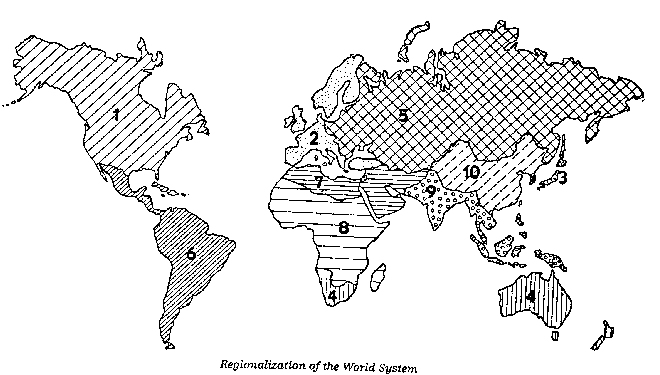
Now what I would like to say, that if you are not interested in the word of God, you will probably walk away saying HO, HUM. But if you are one who pays particular attention to the prophetic word of God, one who is looking for that blessed hope and the glorious appearing of our great God and Saviour Jesus Christ, it should be cause for one to walk away in ecstasy, knowing that "in the days of these kings shall the God of heaven set up a kingdom, which shall never be destroyed" (Dan. 2:44). "For yet a little while, and he that shall come will come, and will not tarry" (Heb. 10:37).
Odds of Probability
If one will consider the odds of probability when looking to the prophetic word of God, one will quickly come to the conclusion that the word of God, the Bible is indeed true and infallible, in all it says about Jesus Christ and history etc. These odds are calculated by taking the odds of each individual prophecy and multiplying them with one another. For example, if the odds of one prophecy is 1 in 12, and another is 1 in 100, the compound odds of probability that both would be fulfilled in one event or person would be (1 x 12) x (1 x 100) = 1200. This means that there would be one chance in 1200 of these two events both coming to pass in one person. In the Old Testament portion of the Bible there are over 300 prophecies in regards to the first coming of the Messiah. We will just take 23 of these prophecies and apply odds to them which will be for the most part very liberal odds, and see what kind of conclusion may be drawn.
1. The Messiah would be born of the tribe of Judah, one of the 12 tribes of Jacob. "The sceptre shall not depart from Judah, nor a lawgiver from between his feet, until Shiloh come; and unto him shall the gathering of the people be" (Genesis 49:10, Luke 3:23-33). Probability is 1 in 12.
2. Messiah would be born in Bethlehem, one of thousands of villages of Judah. "But thou, Bethlehem Ephratah, though thou be little among the thousands of Judah, yet out of thee shall he come forth unto me that is to be ruler in Israel; whose goings forth have been from of old, from everlasting" (Micha 5:2, Mt. 2:1, Luke 2:4-7). Probability is 1 in 1000.
3. The time of the Messiahs birth. "Know therefore and understand, that from the going forth of the commandment to restore and to build Jerusalem unto the Messiah the Prince shall be seven weeks, and threescore and two weeks: the street shall be built again, and the wall, even in troublous times" (Dan. 9:25, Luke 2:1-2). Probability is 1 in 1000.
4. The Messiah would be born of a virgin. "Therefore the Lord himself shall give you a sign; Behold, a virgin shall conceive, and bear a son, and shall call his name Immanuel" (Isaiah 7:14, Mt. 1:22-23). Probability is 1 in 1000.
5. He would be the heir to the throne of David. "Of the increase of his government and peace there shall be no end, upon the throne of David, and upon his kingdom, to order it, and to establish it with judgment and with justice from henceforth even for ever. The zeal of the LORD of hosts will perform this" (Isaiah 9:7, Luke 1:32). Probability is 1 in 1000.
6. He would be called out of Egypt. "When Israel was a child, then I loved him, and called my son out of Egypt" (Hosea 11:1, Mt. 2:14-15). Probability is 1 in 100.
7. He would be called a Nazarene. The name Nazareth means a shoot or branch. "And there shall come forth a rod out of the stem of Jesse, and a Branch shall grow out of his roots" (Isaiah 11:1, Mt. 2:23, John 1:46). Probability is 1 in 100.
8. His way would be prepared before Him. "The voice of him that crieth in the wilderness, Prepare ye the way of the LORD, make straight in the desert a highway for our God. Every valley shall be exalted, and every mountain and hill shall be made low: and the crooked shall be made straight, and the rough places plain: And the glory of the LORD shall be revealed, and all flesh shall see it together: for the mouth of the LORD hath spoken it" (Isaiah 40:3-5, Luke 3:3-6). Probability is 1 in 50.
9. His Galilean ministry. "Nevertheless the dimness shall not be such as was in her vexation, when at the first he lightly afflicted the land of Zebulun and the land of Naphtali, and afterward did more grievously afflict her by the way of the sea, beyond Jordan, in Galilee of the nations. The people that walked in darkness have seen a great light: they that dwell in the land of the shadow of death, upon them hath the light shined" (Isaiah 9:1-2, Mt. 5: 12-16). Probability is 1 in 5.
10. His many miracles. "They shall see the glory of the LORD, and the excellency of our God. Strengthen ye the weak hands, and confirm the feeble knees. Say to them that are of a fearful heart, Be strong, fear not: behold, your God will come with vengeance, even God with a recompence; he will come and save you. Then the eyes of the blind shall be opened, and the ears of the deaf shall be unstopped. Then shall the lame man leap as an hart, and the tongue of the dumb sing" (Isaiah 6:2-6, Mt. 4:23-24, 11:2-6, John 7:31). Probability is 1 in 1000.
11. He would enter Jerusalem on a colt. "Rejoice greatly, O daughter of Zion; shout, O daughter of Jerusalem: behold, thy King cometh unto thee: he is just, and having salvation; lowly, and riding upon an ass, and upon a colt the foal of an ass" (Zech. 9:9, Luke 19:35-37). Probability is 1 in 10.
12. He would be betrayed by a friend. "Yea, mine own familiar friend, in whom I trusted, which did eat of my bread, hath lifted up his heel against me" (Psalm 41:10, Mt. 26:47-50). Probability is 1 in 10.
13. He would be betrayed for thirty piesces of silver. "And I said unto them, If ye think good, give me my price; and if not, forbear. So they weighed for my price thirty pieces of silver. And the LORD said unto me, Cast it unto the potter: a goodly price that I was prised at of them. And I took the thirty pieces of silver, and cast them to the potter in the house of the LORD" (Zech. 11:12-13, Mt. 26:15). Probability is 1 in 50.
14. He would be rejected by his own people the Jews. "He is despised and rejected of men; a man of sorrows, and acquainted with grief: and we hid as it were our faces from him; he was despised, and we esteemed him not" (Isaiah 53:3, John 1:11, Luke 23:18). Probability is 1 in 2.
15. He would be silent before his own accusers. "He was oppressed, and he was afflicted, yet he opened not his mouth: he is brought as a lamb to the slaughter, and as a sheep before her shearers is dumb, so he openeth not his mouth" (Isaiah 53:7, Mt. 27:12-14). Probability is 1 in 100.
16. He would be spat on and struck. "I gave my back to the smiters, and my cheeks to them that plucked off the hair: I hid not my face from shame and spitting" (Isaiah 50:6, Mt. 26:67). Probability is 1 in 10.
17. He would be crucified. "I am poured out like water, and all my bones are out of joint: my heart is like wax; it is melted in the midst of my bowels. My strength is dried up like a potsherd; and my tongue cleaveth to my jaws; and thou hast brought me into the dust of death. For dogs have compassed me: the assembly of the wicked have inclosed me: they pierced my hands and my feet. I may tell all my bones: they look and stare upon me. They part my garments among them, and cast lots upon my vesture" (Psalm 22:14-18, Matthew 27:35). Probability is 1 in 100.
18. He would be crucified with malefactors. "Therefore will I divide him a portion with the great, and he shall divide the spoil with the strong; because he hath poured out his soul unto death: and he was numbered with the transgressors; and he bare the sin of many, and made intercession for the transgressors" (Isaiah 53:12, Mk. 15:27). Probability is 1 in 10.
19. He would have his side pierced. "And I will pour upon the house of David, and upon the inhabitants of Jerusalem, the spirit of grace and of supplications: and they shall look upon me whom they have pierced, and they shall mourn for him, as one mourneth for his only son, and shall be in bitterness for him, as one that is in bitterness for his firstborn" (Zech. 12:10, John 19:34, 37). Probability is 1 in 10.
20. None of His bones would be broken. "He keepeth all his bones: not one of them is broken" (Psalm 34:20, John 19:32-36). Probability is 1 in 10.
21. His sacrificial death. "But he was wounded for our transgressions, he was bruised for our iniquities: the chastisement of our peace was upon him; and with his stripes we are healed" (Isaiah 53:5, Eph. 5:2, Galatians 1:4, Romans 5:6-8). Probability is 1 in 100.
22. He would be buried with the rich. "And he made his grave with the wicked, and with the rich in his death; because he had done no violence, neither was any deceit in his mouth" (Isaiah 53:9, Mt. 27:57-60). Probability is 1 in 10.
23. His bodily resurrection. "For thou wilt not leave my soul in hell; neither wilt thou suffer thine Holy One to see corruption" (Psalm 16:10, Mt. 28:6-7). Probability is 1 in 1000.
When these 23 prophecies are taken and the odds of probability are calculated, the figure is staggering. That these 23 prophecies would be fulfilled in one person, the Messiah, is calculated to be 3 x 10 to the 37th power. In other words, one chance in 30,000,000,000,000,000,000,000,000,000,000,000,000. In fact there are over 300 prophecies regarding the first coming of the Messiah. Dr. Henry Morris, in his book "The Bible and Modern Science" has shown that the probability of the chance fulfillment of only forty-eight of these messianic prophecies by one person is only one chance in 10 to the 181st power. It is the same as saying that they were not fulfilled accidentally or by chance, but rather by divine omniscience. These are prophecies that were told by God through the prophets.
The apostle Paul would say, "Having therefore obtained help of God, I continue unto this day, witnessing both to small and great, saying none other things than those which the prophets and Moses did say should come: That Christ should suffer, and that he should be the first that should rise from the dead, and should shew light unto the people, and to the Gentiles" (Acts 26: 22-23). Christ would tell the two doubters on the road to Emmaus, "O fools, and slow of heart not to believe all that the prophets have spoken: Ought not Christ to have suffered these things, and to enter into his glory? And beginning at Moses and all the prophets, he expounded unto them in all the scriptures the things concerning himself" (Luke 24:25-27). The apostle John would say, "And many other signs truly did Jesus in the presence of his disciples, which are not written in this book: But these are written, that ye might believe that Jesus is the Christ, the Son of God; and that believing ye might have life through his name" (John 21:30-31).
Appendix B
Satan's Throne
It is interesting to note that the dragon at the first has seven crowns upon
his seven heads. (Rev. 12:3) This may signify that
Satan's influence has dominated the seven kingdoms of this world which are
represented by the crowns upon the seven heads
or kingdoms (Rev. 20:3, 8, 12:9, 17:10). The kingdoms of Egypt, Assyria,
Babylon, Medo-Persia, Grecian, and Rome have all
had an influence over the nation Israel. The Lord spoke through the prophet
Zechariah,
"For thus saith the LORD of hosts;
After the glory hath he sent me unto the nations which spoiled you: for he that
toucheth you toucheth the apple of his eye"
(2:8).
Now that Israel is once again a nation we may see how it is possible for the
seventh kingdom to arise and have its influence
over the nation Israel, even as the antichrist will.
Satan's Throne
When the beast arises out of the sea of humanity (Isaiah 57:20), the crowns are then found to rest on the ten horns (Rev. 13:1), which represent the seventh kingdom (Rev. 17:12). The seventh kingdom in the Revelation is the kingdom in focus here in the latter days. The beast or the antichrist is the eighth and is said to be "of the seven" (Rev. 17:11) He proceeds out of the seven and is the ultimate embodiment of all the God-opposed features of the previous seven, concentrated and consummated.
As Christianity began to embrace the world, Jesus told the church at Pergamos, "I know thy works, and where thou dwellest, even where Satan's seat is" . Where is Satan's throne? First, let us remember what Jesus said regarding his kingdom, "My kingdom is not of this world" (John 18:36), but He gave us an example to pray, "thy kingdom come thy will be done in earth as it is in heaven" (Mt. 6:10). Today Christ is seated at the right hand of His Father waiting till his enemies be made his footstool.
In the mean time, it is "Satan, which deceiveth the whole world" (Revelation 12:9). He is the "prince of the power of the air" who "as a roaring lion, walketh about seeking whom he may devour." He is "the god of this world hath blinded the minds of them which believe not" (2 Corinthians 4:4). We are told "be not conformed to this world" (Romans 12:2), for "the whole world lieth in wickedness" (1John 5:19), and "the works thereof are evil" (John 7:7).
Therefore we are admonished "No man that warreth entangleth himself with the affairs of this life (world); that he may please him who hath chosen him to be a soldier" (2 Tim. 2:4). A church which calls itself Christian and yet courts alliance with the godless system of this world commits spiritual adultery. The apostle James says, "Ye adulterers and adulteresses, know ye not that the friendship of the world is enmity with God? whosoever therefore will be a friend of the world is the enemy of God" (James 4:4). Jesus said, "If the world hate you, ye know that it hated me before it hated you. If ye were of the world, the world would love his own: but because ye are not of the world, but I have chosen you out of the world, therefore the world hateth you" (John 15:18,19). Therefore, "Love not the world, neither the things that are in the world. If any man love the world, the love of the Father is not in him" (1 John 2:15) It is Jesus "who gave himself for our sins, that he might deliver us from this present evil world, according to the will of God and our Father" (Galatians 1:4) "Wherein in time past ye walked according to the course of this world, according to the prince of the power of the air" (Ephesians 2:2).
I believe we can safely say that Satan's throne for the time being is on planet Earth. He is "the prince of this world" (John 12:31). When Satan offered the kingdoms of this world to Christ (Mt. 4:8-10), he could rightly do so. When Adam sinned he sold out his right to the rulership and dominion of this world that God had given him, somewhat like when Esau sold his birthright for a pot of porridge to Jacob. He lost his dominion when he sinned (Romans 5:12), and death now reigns.
Christ said, "My kingdom is not of this world" (John 18:36). During the tribulation we find an angel pouring "out his vial upon the seat of the beast; and his kingdom was full of darkness" (Rev. 16:10). Another angel sounded, and there were great voices from heaven saying, "The kingdoms of this world are become the kingdoms of our Lord, and of his Christ; and he shall reign forever and ever" (Rev. 11:15). Jesus Christ is indeed going to set up his kingdom on this earth and reign for ever, but His kingdom is yet to come. For now, He is gone "into a far country to receive for himself a kingdom, and to return" (Luke 19:12). One day he will return and sit upon the throne of his father David. When He sits upon the throne He will "put down all rule and all authority and power. For he must reign, till he hath put all enemies under his feet" (1Cor. 15:24-25). May our focus be on Jesus Christ and His coming, and not preoccupied with the things of this world, which are but chaff in the wind.
If we could learn from history, we see that trying to mix Christianity with the world system, the Church and State, results in apostate Christianity. If only Christendom could see, that getting involved with the affairs of this world, only result in the Christian becoming more like the world, not the other way around. The Apostle Paul would tell the carnal Corinthians, "Be not deceived: evil communications corrupt good manners. Awake to righteousness, and sin not; for some have not the knowledge of God: I speak this to your shame" (1Cor. 15:33-34).
But all throughout history there was always a faithful remnant who would stand
up for the truth of the gospel and counted
themselves as
"strangers and pilgrims on the earth"
, who
"desire a better country, that is, an heavenly: wherefore God is not
ashamed to be called their God: for he hath prepared for them a city"
(Hebrews 11:13,16). Abraham, the father of the faithful,
did not look to this world for a kingdom.
"By faith he sojourned in the land of promise, as in a strange country,
dwelling in
tabernacles with Isaac and Jacob, the heirs with him of the same promise: For
he looked for a city which hath foundations,
whose builder and maker is God"
(Hebrews 11:8-10).
"For here have we no continuing city, but we seek one to come"
(Heb.
13:4).
"We look not at the things which are seen, but at the things which are not
seen: for the things which are seen are temporal;
but the things which are not seen are eternal"
(2 Corinthians 4:18).
