According to the Scriptures"Moreover, brethren, I declare unto you the gospel... By which also ye are saved... unless ye have believed in vain. For I delivered unto you first of all that which I also received, how that Christ died for our sins according to the scriptures; And that he was buried, and that he rose again the third day according to the scriptures" (1 Corinthians 15:1-4)


Mystery of the Maya and Aztecs
SOLVED

Unlocking the Mysteries of the Inhabitants,
Languages and Religions of the World


Mystery, Babylon the Great


"… and great Babylon came in remembrance before God, to give unto her the cup of the wine of the fierceness of his wrath … I will shew unto thee the judgment of the great whore…" (Revelation 16:19, 17:1).

The Woman

"MYSTERY, BABYLON THE GREAT, THE MOTHER OF HARLOTS AND ABOMINATIONS OF THE EARTH" (Revelation 17:5), that is the name written upon the head of "the great whore" (Revelation 17:1) that John saw sitting upon "a scarlet colored beast… having seven heads and ten horns" (Revelation 17:3).

She was clothed in lavish apparel, "arrayed in purple and scarlet colour, and decked with gold and precious stones and pearls, having a golden cup in her hand full of abominations and filthiness of her fornication" (Revelation 17:4), and she was "drunken with the blood of the saints, and the blood of the martyrs of Jesus" (Revelation 17:6), and all the inhabitants of the earth were "made drunk with the wine of her fornication" (Revelation 17:2).

When the apostle John saw her, he "wondered with great admiration" (Revelation 17:6). John was totally amazed at what he saw. The angel of the Revelation then said, "Wherefore didst thou marvel? I will tell thee the mystery of the woman, and of the beast that carrieth her, which hath the seven heads and ten horns" (Revelation 17:7).

The word "Revelation" comes from the Greek word apokalupsis, which means to unveil or uncover those things that were previously hidden. The angel now says he will clearly reveal to us the mystery of the woman and of the beast that carries her. After the explanation we should have no question as to what the woman and the beast signify.

The angel said the woman was sitting upon "many waters" (Revelation 17:1), which he explains are "peoples, and multitudes, and nations, and tongues" (Revelation 17:15). Her evil influence has affected the whole world therefore it is fitting that she is called the "ABOMINATIONS OF THE EARTH".

The woman is seen sitting on a beast as well as the "seven heads" of the beast. The "seven heads are seven mountains" (Revelation 17:9), which represent "seven kings" (Revelation 17:10) or kingdoms. At the time that John wrote the Revelation five of these kingdoms had already come and gone. One presently existed ("one is" - Roman Empire - sixth), and the seventh kingdom was still to come (Revelation 17:9-10).

But the complete seven-headed ten-horned beast represented the "eighth" (Revelation 17:11) and final world kingdom before Christ returns. We are told that the eighth kingdom "was, and is not" (Revelation 17:8), that is, it existed in the past, but ceased to exist at the time when John penned the Revelation. However, one day the beast would "ascend out of the bottomless pit", and "they that dwell on the earth shall wonder … when they behold the beast that was, and is not, and yet is" (Revelation 17:8).

After these descriptions the angel comes right out and tells John, "the woman which thou sawest is that great city, which reigneth over the kings (kingdoms) of the earth" (Revelation 17:18). We must wonder as John, what "great city" has influenced or reigned over the kingdoms of the world down throughout history? Is she Jerusalem, Washington, Moscow, or perhaps Rome? These and many other cities have been suggested, however, as we search the Scriptures, I believe we will find it absolutely indisputable as to what great city she signifies.

This great city must have existed prior to the seven kingdoms (represented by the seven heads of the beast) in order to exercise her influence over them. It is said that she "reigneth" (Greek echo: to have or hold in possession) over all the kings/kingdoms of the earth.

Although she did not exist as the predominant physical and geographical city at the time when John wrote the Revelation (Rome was the capital city of the Roman Empire, the sixth kingdom), she existed as a great city in the past and will rise up again only to be judged by God in the latter days. We must remember as well that the beast that carried her "was, and is not, and shall ascend" (Revelation 17:8). It appears then, that when this eighth kingdom ascends to power she too will be exalted as the great and mighty city of the beast.

What "great city" is she then? Is she Jerusalem? We must say no, for "Jerusalem … is the city of the great King" (Matthew 5:35) where the Lord said He would put His "name for ever" (2 Chronicles 33:7). The Lord may have lamented, "How is the faithful city become an harlot!" (Isaiah 1:21), but this woman is called the "MOTHER OF HARLOTS". While Jerusalem is called "the great city" (Revelation 11:8), it is not "that great city" (17:18).

Many have speculated that the USA is this great whore, but the USA is not a city, it is a nation. She may be a superpower today, but she has never reigned over all the kingdoms of the earth throughout history.

Is she then Rome? We must admit that the overwhelming majority of Christians (especially the so called "Protestants" and "Reformers") identify the great whore of Revelation 17 as Rome, or to be more precise, the Roman Catholic Church, but this is not so.

Rome's influence never reigned over the five kingdoms that had previously come and gone before her, nor is the Roman Catholic Church a city. Furthermore, John saw upon this woman's forehead "a name written … BABYLON THE GREAT", and was told quite clearly that the "woman which thou sawest is that great city" (Revelation 17:5, 18).

Babylon is referred to in the book of the Revelation as an actual city not just a symbol, and there is no reason to believe it is other than literal Babylon. It is referred to as "that great city" six times (Revelation 14:8, 17:18, 18:10, 16, 19, 21), "Babylon the great" twice (Revelation 17:5, 18:2), "great Babylon" (Revelation 16:19) once and "this great city" (Revelation 18:18) once.

Babylon is clearly identified as "that great city". Rome is not mentioned once in the Revelation. If the angel of the Revelation meant Rome He would have revealed that to John. But John recorded that the woman was "that great city Babylon" (Revelation 18:10).

You would have to spiritualize the Scriptures rather than taking a contextual, and therefore, literal interpretation to come up with Rome. Some have alleged that "Babylon" was a "code word" used to refer to Rome. However, there is nothing to substantiate that claim. When Paul wrote his letter to the church at Rome he used no such code word and Peter's referral to the "church at Babylon" (1 Peter 5:13) was to the Christian Church that was established in Babylonia. There is no reason to believe otherwise.

The Beast

When we look at "the beast" that carries the "great whore", we are given further revelation into this mystery. The seven heads of the beast represented seven kingdoms, but after this there was an "eighth" kingdom. We are told that this eighth kingdom "was, and is not; and shall ascend out of the bottomless pit".

This eighth kingdom existed in the past and would be revived again. The "woman" who is carried by this beast represented "that great city Babylon", which will be the capital of the "eighth" kingdom. We must conclude therefore that this eighth kingdom be Babylon revived.

We must remember that before any of the kingdoms (seven heads) of the world were ever formed, Babylon was "the beginning of [Nimrod's] kingdom" (Genesis 10:10). This was the first city and kingdom that was built upon the plains of Shinar, approximately 100 years after the worldwide Flood in Noah's day.

After the Flood washed the earth clean of all corruption, violence and wickedness, God told Noah and his sons, "Be fruitful, and multiply, and replenish the earth" (Genesis 9:1). It was God's will for man "to dwell on all the face of the earth" (Acts 17:26). But here Nimrod, the great grandson of Noah, organized another great rebellion, no doubt instigated by Satan, saying, "let us build us a city and a tower, whose top may reach unto heaven; and let us make us a name, lest we be scattered abroad upon the face of the whole earth" (Genesis 11:4).

Rather than fill the earth, they disobeyed God's command and began to build their own kingdom beginning with a city and a tower to unite and bind them together. This would be the center for their new political, commercial and religious world order. However, God's purpose would not be undone so He intervened and confused the language of these rebel's, "and from thence did the LORD scatter them abroad upon the face of all the earth" (Genesis 11:9), "every one after his tongue, after their families, in their nations" (Genesis 10:5).

Each family was now given a new language that distinguished them as a nation. However, when these rebels were scattered to form the nations of the world, they brought with them their corrupt religious, political, architectural and commercial philosophies that were formed at Babel, filling the earth with her abominations.

A study of the world's religions will show that they are all quite similar, only that their gods have different names because of the different dialects that were produced at Babel. This is clearly revealed in the venerable work of Alexander Hyslop in his book entitled "The Two Babylon's".

Babylon's influence grievously affected all the nations of the world. "All nations have drunk of the wine of the wrath of her fornication, and the kings of the earth have committed fornication with her" (Revelation 18:3). She is without a doubt the fountainhead and architect of all corruption and false religion and all the nations followed her ways.

This "great city" is truly "THE MOTHER OF HARLOTS AND ABOMINATIONS OF THE EARTH" (Revelation 17:5). This was a great mystery, which perhaps the people of God should have already recognized, but now it is clearly unveiled in the book of the Revelation.

This woman is also called "the great whore". The word "whore" comes from the Greek word porne, which is similar to pornos and porneia that is translated "fornication" and "fornicator". To commit fornication is to commit any sexual act outside of marriage. She is the great fornicator for "she made all nations drink of the wine of the wrath of her fornication" (Revelation 14:8), and her spawn was spread out from Babel.

In a spiritual sense a fornicator would refer to anyone who worships or serves other "gods" rather than the one true God and Creator. This woman has truly spawned all the false religions of the nations that departed from the one true God. The religions of polytheism, pantheism, animism, or any of the modern religions of today, whether they understand it or not, all have their roots that go back to Babel where mankind turned away in rebellion against their Creator.

Babylon's influence has unquestionably reigned over the kingdoms of this world and this is why she is called the "ABOMINATIONS OF THE EARTH". She influenced Israel in the Old Testament as Isaiah lamented, "How is the faithful city become an harlot" (Isaiah 1:21). And since New Testament times, the "church" has jumped into bed with her, primarily the Roman Catholic Church which became the "state church" when Christianity was legalized in the fourth century by the Roman Emperor Constantine.

Roman Catholicism clearly does not fit the description as the originator or mother of all false religion. She may have committed fornication, adopting many of the tenants of paganism and become a harlot, much like Israel did in the Old Testament, however, Babylon is clearly the "MOTHER OF HARLOTS".

Many have concluded that Rome is "that great city" because she is situated on "seven hills". Encyclopedia Britannica identifies Rome as "The city of the seven hills, of treasures and tourists…" (26:980), and the Bible tells us, "The seven heads are seven mountains, on which the woman sitteth" (Revelation 17:9).

It should be noted however, that Rome is said to be the city of seven "hills" [Greek bounos], not "mountains" [Greek oros] as recorded in the Bible. There is a difference between a mountain and a hill! As well, the Roman Catholic Church does not sit on the Seven Hills of Rome, its headquarters are in Vatican City, and Rome is actually situated on more than seven hills.

Furthermore, the mountains actually symbolize seven kingdoms for we are told that the "seven heads [of the beast] are [Greek eisi] seven mountains [Greek oros], on which the woman sitteth. And there are [Greek eisi; translated at least 23 times as "they are" or usually just "are"] seven kings" (Revelation 17:9-10). So, the "seven heads are seven mountains", and "they are seven kings".

(Seven heads = seven mountains = seven kings)

There is no need to step outside of the Scriptures to interpret what these seven heads and mountains represent. The angel of the Revelation plainly reveals to John that they are "seven kings" or kingdoms. Elsewhere in the Bible "mountains" are often used to symbolize kingdoms or government (Isaiah 2:2, 13:1-2, 40:4, Daniel 2:34-35, Jeremiah 51:24-25, Zechariah 4:7, Micah 4:1-2). Therefore, in this specific context, the "mountains" are symbolic and we are told what they signify.

Of these seven kingdoms, "five are fallen, and one is, and the other is not yet come" (Revelation 17:10). When John wrote the Revelation five of these kingdoms were already fallen. Rome was the sixth kingdom and the seventh was "not yet come". The seventh kingdom would be a revised or divided Roman Empire ruled by a 10-king confederacy represented by the "ten horns" on the seventh head of the beast. And in the days of this ten king confederacy the "eighth" (Revelation 17:11) and final kingdom would ascend, represented by the complete seven-headed, ten-horned beast, for "the beast is… is the eighth" (Revelation 17:11).

Many have come to the conclusion that the beast represents a revived Roman Empire, however this cannot be for we are told that this "beast … was, and is not; and shall ascend … [and of the] seven kings: five are fallen, and one is [sixth], and the other is not yet come [seventh] … And the beast that was, and is not, even he is the eighth" (Revelation 17:8, 10-11).

When John wrote the Revelation the sixth kingdom was the Roman Empire ("one is"). At the same time we are told that the beast "was, and is not". We are told "one is" and the other "is not". The language is very clear. The beast existed before the Roman Empire but "is not" the Roman Empire but would be revived in the last days as the "eighth" kingdom.

Zechariah's Vision

As with every kingdom, they all have a capital city where the king resides and rules. The capital of the beast will neither be Rome or Washington, neither will it be Jerusalem, but Babylon rebuilt as seen in a vision by the prophet Zechariah.

An angel showed Zechariah a "woman" in an "ephah" with a "talent of lead" covering the mouth. An "ephah" was a measuring basket and a "talent of lead" was a weight. Both of these were used in commerce. The angel then said this was "their resemblance throughout all the earth … This is wickedness" (Zechariah 5:6, 8).

The Bible tells us, "the love of money is the root of all evil" (1 Timothy 6:10). When economy and commerce becomes the most important thing to a nation and corrupt religion permeates society, "This is wickedness" (Zechariah 5:8). In the last days Zechariah says this would be "their resemblance throughout all the earth" (Zechariah 5:6).

He then saw the "woman" inside the "ephah" with the "talent of lead" on the top of her being lifted up by two other women with wings as storks. Zechariah then asked, "Whither do these bear the ephah?" And the angel replied, "To build it an house in the land of Shinar: and it shall be established, and set there upon her own base" (Zechariah 5:11).

Zechariah saw that the whole world would be caught up in this "wickedness". It would be "their resemblance throughout all the earth". However, this great commercial and religious system began back in Babylon and was carried throughout the whole world on the backs of the nations when the Lord confused their language and scattered them upon the face of all the earth. Once it had permeated the whole earth its headquarters would be reestablished upon her old foundation back in the "land of Shinar" (Zechariah 5:11).

The "land of Shinar" (Daniel 1:1-2) is also referred to as, "the land of Babylon" (Jeremiah 51:29) and "the land of Nimrod" (Micah 5:6). Nimrod became the world's first dictator organizing a single government under his rule and the "beginning of his kingdom was Babel… in the land of Shinar" (Genesis 10:10).

This was the beginning of mankind's empire building schemes to make a name for himself, in direct conflict with the will of God. The consummation of man's self willed ambitions will be Babylon rebuilt and reestablished as the Antichrist's center of world government as described very lavishly in Revelation chapters 17 and 18.

The rebuilding of Babylon will make many filthy rich when it is restored "by reason of her costliness" (Revelation 18:19). However, when "success" becomes the primary focus of mankind, and their hope is in the riches of this world, they will be ripe to worship the Antichrist, for he will cause "all, both small and great, rich and poor, free and bond, to receive a mark in their right hand, or in their foreheads: And that no man might buy or sell, save he that had the mark, or the name of the beast, or the number of his name" (Revelation 13:16-17).

In effect, if they want to participate in this economic stimulation package they will have to sell their souls to the devil. But it will be all in vain for the merchants of the earth shall wail greatly saying, "What city is like unto this great city!" (Revelation 18:18) when she is judged by God and quickly and finally brought to desolation and overthrown as "Sodom and Gomorrah" (Jeremiah 50:40) and "utterly burned with fire" (Revelation 18:8), then finally "cast … into the sea" (Revelation 18:21).

The prophet Jeremiah said that Babylon would be overthrown as "Sodom and Gomorrah" (Jeremiah 50:40). This has never been fulfilled in the history of the world. Many prophecies in the Bible have a near and far application and sometimes all of the details are not fulfilled in the first application.

When Babylon was conquered, she was not overthrown as Sodom and Gomorrah. She was "divided, and given to the Medes and Persians" (Daniel 5:28). However, one day in the future, Babylon shall "be utterly burned with fire" (Revelation 18:8).

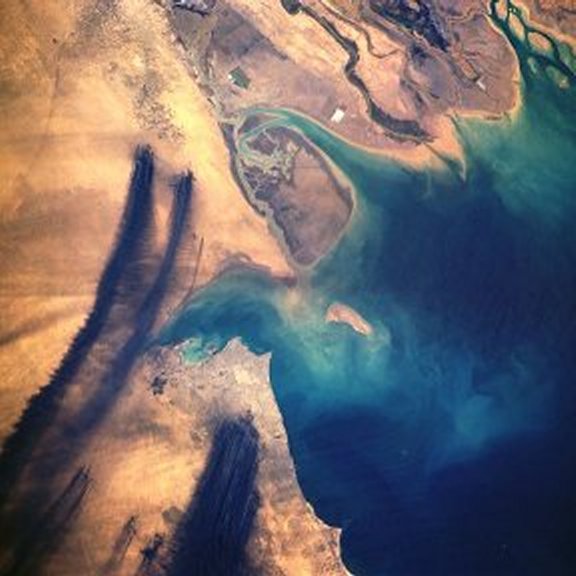
The Middle East is known for its great oil reserves, and perhaps you will remember the Gulf War of 1991, when many oil wells were left burning after the liberation of Kuwait. It took over a year with the help of the International Community to get all of those wells put out.

Kuwait Fires
Kuwait oil wells burning (1991)


Imagine when Babylon is destroyed as Sodom and Gomorrah, the world "shall see the smoke of her burning" (Revelation 18:9) via satellite TV, with the merchants "stand [ing] afar off for the fear of her torment, weeping and wailing" (v. 15), for they "cried when they saw the smoke of her burning, saying, What city is like unto this great city!" (v. 18), and none can save her.

With such a great overthrow, how could this fire ever be put out? It will take more than an international effort, it will take the intervention of God, and so we read, Babylon shall be "cast… into the sea" (v. 21). "Thus shall Babylon sink, and shall not rise…" (Jeremiah 51:63-64).

Jeremiah also said that Babylon "shall be no more inhabited for ever; neither shall it be dwelt in from generation to generation" (Jeremiah 50:39). This has not yet been fulfilled either. Even recently, the fallen dictator of Iraq (location of ancient Babylon) has invested much effort to rebuild and revive the Babylon of King Nebuchadnezzar's antiquity. And since his overthrow, the "Future of Babylon Project" has been launched by the World Monuments Fund and UNESCO, which intends on making Babylon "fit for the coveted title of World Heritage site", with funding by the US Dept of State and in collaboration with Iraq's State Board of Antiquities and Heritage.

There are many Scriptures in the Old Testament concerning Babylon and its future establishment that are reiterated in the New Testament. John was told that this harlot "sitteth upon many waters" (Revelation 17:1). Jeremiah said the same, "O thou that dwellest upon many waters, abundant in treasures, thine end is come, and the measure of thy covetousness" (Jeremiah 51:13). John also repeated (Revelation 17:1-2) what Jeremiah said long ago. "Babylon hath been a golden cup in the LORD'S hand, that made all the earth drunken: the nations have drunken of her wine; therefore the nations are mad" (Jeremiah 51:7).

The ancient cry was, "My people, go ye out of the midst of her, and deliver ye every man his soul from the fierce anger of the LORD" (Jeremiah 51:45). This cry will be echoed in the future when God judges Babylon for the final time. "Come out of her, my people, that ye be not partakers of her sins, and that ye receive not of her plagues. For her sins have reached unto heaven, and God hath remembered her iniquities" (Revelation 18:4-5).

As God called Lot out of Sodom and Gomorrah before its destruction, so too will God call his people out of Babylon before her final judgment.

This is what the Bible says concerning Babylon, then and now, we just need to believe God for, "the testimony of the LORD is sure, making wise the simple" (Psalms 19:7).

The Beast with Seven Heads and Ten Horns

Just as we are told the mystery of the woman, we are also told the mystery of the "beast". It is quite obvious what the beast signifies, for the angel plainly tells John that "the beast … is the eighth" king/kingdom (Revelation 17:11). Further details tell us that this beast "was, and is not; and shall ascend out of the bottomless pit, and go into perdition" (Revelation 17:8), and many will be amazed when "they behold the beast that was, and is not, and yet is" (Revelation 17:8).

The language is clear that this "eighth" kingdom existed in the past, but did not exist at the time John wrote the Revelation but finally it "shall ascend". The beast then, is evidently a revived kingdom, but could not be a "Revived" Roman Empire for the Roman Empire existed ("one is") at the time when John wrote the Revelation and at that time "the beast" did not exist ("is not"). Furthermore, the Roman Empire never really ceased to exist, rather, it has been "Revised" down through the past two millennia and lives on in the nations of this day.

The prophet Daniel said that the Roman Empire "shall be divided" (Daniel 2:41), and that it would "be partly strong, and partly broken". The Roman Empire was never defeated like its predecessor kingdoms but became fragmented. It was first divided between east and west represented by the two legs of Daniel's vision (Daniel 2:33), and in its final form it would be divided into a ten-king confederacy as represented by the "ten toes" of Daniel's image (Daniel 2:41-42). The "ten toes" of this image correspond to the "ten horns" of the beast as seen in Daniel chapter 7 and Revelation chapters 12, 13 and 17.

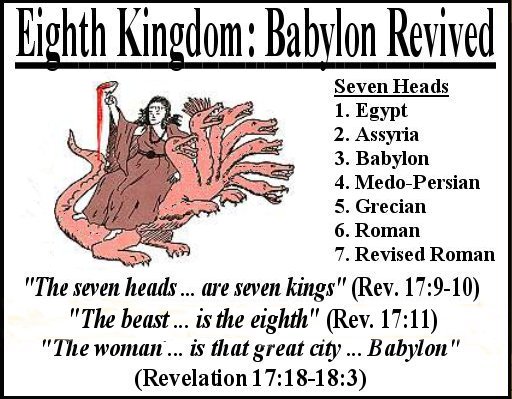
The "beast … which hath the seven heads" is said to be the "eighth", but at the same time it is also said to be "of the seven" (Revelation 17:11). These "seven heads", as we have stated, are "seven kings" that represent the successive kingdoms down through the history of the world. As each kingdom ascended to power they were eventually succeeded and refined by the next kingdom up until the eighth whose final form is portrayed by the seven-headed, ten horned beast.

In the book of Daniel we see a similar formation of this final kingdom. Daniel saw the kingdoms throughout history being built one upon the other, molded together to form one great abominable idol that the Lord will smash when He returns.

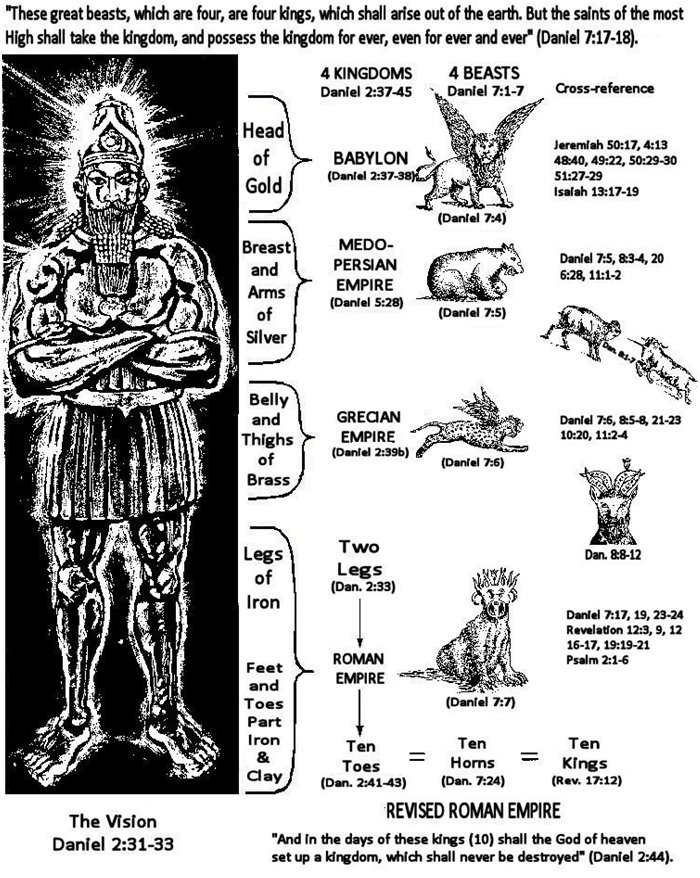
Daniel saw an image whose "head was of fine gold, his breast and his arms of silver, his belly and his thighs of brass, His legs of iron, his feet part of iron and part of clay" (Daniel 2:32-33).

Eighth Kingdom


The "head of gold" was Babylon (Daniel 2:38, Jeremiah 27:5-7), the "breast and his arms of silver" was the Medo-Persian Empire (Daniel 2:39, 5:28, 6:28, 7:5, 8:20, 11:1-2), the "belly and his thighs of brass" was the Grecian Empire (Daniel 2:39, 7:6, 8:5-8, 21-23, 11:3-4), and finally, the "legs of iron, his feet [and toes] part of iron and part clay", represent the Roman Empire (Daniel 2:40-44, 7:7-8, 19-27).

Daniel had another vision after this of "four great beasts" (Daniel 7:2-3) that came up from the sea, which represented these same kingdoms. Daniel was told, "These great beasts, which are four, are four kings, which shall arise out of the earth" (Daniel 7:17). He was also told that the fourth beast (representing the Roman Empire) would devour the whole earth and it had "ten horns" (Daniel 7:7). It was then explained that "the ten horns out of this kingdom are ten kings that shall arise: and another shall arise after them" (Daniel 7:23-24).

If we go back to John's Revelation concerning "the beast … which hath the seven heads and ten horns" (Revelation 17:7), we will see the relationship between Daniel's vision and the Revelation of John. The seven heads were seven kingdoms. In the Apostle John's day the Roman Empire was dominant over all the earth but five kingdoms were already fallen (Revelation 17:10).

For certain, at least from Daniel's time, the Babylonian, Medo-Persian and Grecian Empires had all come and gone. This leaves two more that were before the time of Daniel that had already fallen which were likely Assyria (Jeremiah 50:17) and Egypt (Exodus 1:1-14). All of these kingdoms were in opposition to the one true God and against His people.

Eighth Kingdom


Now of these seven kingdoms, one existed when John wrote the Revelation ("one is" Revelation 17:10, the sixth = Roman Empire), and the seventh was "not yet come". This seventh head or kingdom also had "ten horns", which are ten kings.

In Daniel's vision these "ten kings" are said to arise "out of this kingdom" (Daniel 7:24, the Roman Empire), rather than conquering it. So the seventh kingdom (ten kings) in John's Revelation is really a revision of the Roman Empire, not a revived Roman Empire for the ten kings are said to arise "out of" the Roman Empire.

Edward Gibbons, a great historian, wrote a popular book entitled "The Decline and Fall of the Roman Empire". Although it is very good in its estimation of Rome, the title is a little misleading for the Roman Empire never really fell, rather, as Daniel said, it "shall be divided; but there shall be in it the strength of the iron, forasmuch as thou sawest the iron mixed with clay … the kingdom shall be partly strong, and partly broken" (Daniel 2:41-42).

The Roman Empire was "divided" as indicated by the two "legs of iron" of Daniel's image. The eastern leg of the Roman Empire was centered at Constantinople and the western leg was centered at Rome. At the knees, the Empire was transformed from a political to ecclesiastical structure consisting of the Roman and Byzantine Catholic churches. The western leg became the Holy Roman Empire that spread throughout Western Europe and expanded into the Americas. The eastern leg became the complex of Orthodox churches that spread throughout northern Eurasia.

The Roman Empire may have been weakened by the clay mixed with the iron and become "partly broken", but according to God's Word it did not cease to exist, rather it would be transformed, and in its final form it would be divided into a ten king confederacy represented by the ten toes and ten horns. Although it was divided, its essential character remained the same and its culture, government, language, legal structure, civilization, stretched around the world.

With the dividing of the Roman Empire, it no longer had a centralized government, however, Daniel saw another horn "arise after" the ten, "another little horn" (Daniel 7:8) which is synonymous with "the beast that was and is not, even he is the eighth" (Revelation 17:11).

When this beast rises upon the scene, the ten king confederacy are said to "give their power and strength … [and] their kingdom unto the beast" (Revelation 17:12-13, 17). Under "the beast" there will be a centralized government and the rule of the world will be brought under Antichrist, but from where shall he reign? Where will the Antichrist's throne be?

As we have discussed, this beast/kingdom (eighth) existed in the past and shall be revived. The greatest kingdom that ever existed "was" Babylon, described by God as "the beauty of the Chaldees' excellency" (Isaiah 13:19), and "the golden city" (Isaiah 14:4). It was also described as the "head of fine gold" (Daniel 2:32). The kingdom of Nebuchadnezzar was only a refinement or reincarnation of ancient Babel, which was the "beginning of [Nimrod's] kingdom" (Genesis 10:10).

Nebuchadnezzar revived Nimrod's religion and kingdom, however, this great kingdom with its beautiful capital fell in one night under the reign of Nebuchadnezzar's grandson, Belshazzar. The decree of God had come forth, "God hath numbered thy kingdom, and finished it … In that night was Belshazzar the king of the Chaldeans slain" (Daniel 5:22-30), and his kingdom was taken by the Medes.

When the beast that "was and is not" arises to power again many will wonder when "they behold the beast that was, and is not, and yet is" (17:8). Before we go on, it should be clarified that this beast is both a king and a kingdom. Every kingdom has a king, and who is really a king without a kingdom? These terms are synonymous (example: Daniel 7:17, 23), and this is how we have used this term (king/kingdom) throughout this article. So we will find that "the beast", who is a king, also represents the eighth kingdom.

Now twice we are told that this beast ascends "out of the bottomless pit" (Revelation 11:7, 17:8), but how can a king or a kingdom ascend out of Hades? It is quite remarkable if we turn to the prophet Isaiah, we find a very interesting proverb.

The Lord said, "take up this proverb against the king of Babylon, and say, How hath the oppressor ceased! the golden city ceased" (Isaiah 14:4)! Here we have the "king of Babylon" (likely Belshazzar, Daniel 5:30) and his "golden city", which are both about to come to an end. But what is the end of this great king and his kingdom? We are told, "Hell (Hebrew Sheol, equivalent to Greek Hades) from beneath is moved for thee to meet thee at thy coming … Thy pomp is brought down to the grave (Hebrew Sheol), and the noise of thy viols" (Isaiah 14:9, 11).

Here we have the king of Babylon who represents the kingdom brought down to Hades, but can he ascend out of Hades and rise again a great king and kingdom? Can he "ascend out of the bottomless pit"? We think not, for "it is appointed unto men once to die, but after this the judgment" (Hebrews 9:27). As well, Jesus Christ has the "keys of hell (Greek Hades) and death" (Revelation 1:18), and no man has the power over these but Jesus.

However, further reading of Isaiah's proverb reveals to us that not only is the king the power behind Babylon, but there is someone behind the king, and it is none other than the archenemy of God and His people, Lucifer. "How art thou fallen from heaven, O Lucifer … thou shalt be brought down to hell (Hebrew Sheol), to the sides of the pit" (Isaiah 14:12, 15). It appears that Lucifer accompanied the king of Babylon down to Hades and one day he will be "bound" (Revelation 20:1-2) there for a thousand years, but for now he is free to roam about as a roaring lion seeking whom he may devour (1 Peter 5:8).

So the human king, who represented Babylon, was really possessed and energized and brought to power by Lucifer. As the Bible says, one day this beast will "ascend out of the bottomless pit", at least symbolically, revived and energized by Satan, to become a great world kingdom. God put a stop to the building of Babylon when He confounded their language and scattered the rebels upon the face of the earth. This was Satan's masterpiece and ever since that time he has been seeking to revive it.

The "beast" must represent the Babylonian Empire and its king. The beast/kingdom existed in the past, prior to the Roman Empire, and will be revived as it was previously by Nebuchadnezzar. Satan shall revive them, but in the end the beast shall "go into perdition" (Revelation 17:8, 19:20, 20:10).

And the woman that is carried by this beast must be "that great city Babylon, that mighty city" (Revelation 18:10). She is the epitome of false religion and commercialization. She sat on the seven heads of the beast representing all the kingdoms of history, past, present and future. She rode on the backs of the nations into the whole world filling the earth with her abominations. Her influence reigned over the kingdoms of the earth even though she had declined as a great city. But she had her spawn of "harlots" representing her through the ages whose agenda they fulfilled.

These seven kingdoms all have roots that go back to Babel in the land of Shinar, where that first great rebellion took place, when the post Flood population sought to build a city and a tower unto heaven. But one day the Lord will return and "The kingdoms of this world [will] become the kingdoms of our Lord, and of his Christ; and he shall reign for ever and ever" (Revelation 11:15), and the children of iniquity will no longer "fill the face of the world with cities" (Isaiah 14:21).

The Great Red Dragon

More details regarding "the beast" can be found in Revelation chapters 12 and 13. "And there appeared another wonder in heaven; and behold a great red dragon, having seven heads and ten horns, and seven crowns upon his heads" (Revelation 12:3). Here we have a similar picture of the "scarlet colored beast" mentioned in chapter 17, but here the beast is called the "great red dragon", and is identified as "that old serpent, called the Devil, and Satan, which deceiveth the whole world" (Revelation 12:9).

The fact that the seven heads (kings) are on the Dragon explicitly reveals that he was in control of the seven kingdoms. When Jesus was tempted in the wilderness by the Devil, he showed Him "all the kingdoms of the world in a moment of time" (Luke 4:5), and said, "All this power will I give thee, and the glory of them: for that is delivered unto me; and to whomsoever I will I give it. If thou therefore wilt worship me, all shall be thine" (Luke 4:6-7).

Then, in chapter 13, John "saw a beast rise up out of the sea, having seven heads and ten horns" (Revelation 13:1). But now it says, "the dragon gave him his power, and his seat, and great authority" (Revelation 13:2). The beast is now identified as a man who receives the "power" previously offered to Christ in His temptation in the wilderness.

Satan finally finds his man to whom he can give the "power" over kingdoms of the world and He is none other than the "antichrist" (1 John 2:18), "that man of sin … the son of perdition" (2 Thessalonians 2:3), "that Wicked" (2 Thessalonians 2:8), the "little horn" (Daniel 7:8), the "prince that shall come" (Daniel 9:26) and "the beast" ( Revelation 13:1). He may be fittingly described as Satan incarnate, the man who offers his own soul to gain the whole world. Antichrist shall be possessed and energized by Satan much like when he "entered" Judas to fulfill his will (Luke 22:3).

But then we read, "And I saw one of his heads as it were wounded to death; and his deadly wound was healed: and all the world wondered after the beast" (Revelation 13:3). Here we have another picture of what John saw all along, the kingdom that "was, and is not, and yet is" (Revelation 17:8).

The third head of the beast represented the Babylonian kingdom (which was a revival of Nimrod's kingdom) and the Medo-Persian Empire conquered it, but now it is revived again. But this beast also represents a king, "whose deadly wound was healed" (Revelation 13:12). This, no doubt, is a mock resurrection for it says he was "as it were wounded to death" (Revelation 13:3).

In Revelation 11:7, "the beast that ascendeth out of the bottomless pit" is a man who slays God's two witnesses, while in Chapter 17, the beast that "shall ascend out of the bottomless pit" (Revelation 17:8) is a kingdom. Both of these are revived by Satan, and the whole world will "wonder" (Revelation 13:3, 17:8) when they see Babylon the Great, and its king which "was, and is not, and yet is" (Revelation 17:8), revived and "brought back to life" so to say, and energized by the Dragon. It should only be fitting then that the ten kings should "give their kingdom unto the beast" (Revelation 17:17), "whose deadly wound was healed" (Revelation 13:12).

This eighth beast/kingdom is civic and geographical Babylon revived, and Antichrist shall have his throne there (Revelation 16:10, 13:2), which he receives from the Dragon. The great city Babylon will be rebuilt back on its old foundation in the "land of Shinar" (Zechariah 5:5-11), and when John sees all this, he wonders with great amazement when he sees "the woman", Babylon the Great, as she influenced the nations and the kingdoms of this world down through the ages, revived once again. She rode into the world on the backs of the nations and now she is carried prominently by this seven-headed ten-horned beast.

Satan has energized this eighth and final world kingdom and its king. It is his infernal design and the consummation of his desire to sit as king of the universe, reigning through Antichrist. Long ago he had said in his heart, "I will ascend into heaven, I will exalt my throne above the stars of God: I will sit also upon the mount of the congregation, in the sides of the north: I will ascend above the heights of the clouds; I will be like the most High" (Isaiah 14:13-14).

Satan is called "the god of this world" (2 Corinthians 4:4) for he has deceived the nations (Revelation 20:3), "And they worshipped the dragon which gave power unto the beast: and they worshipped the beast, saying, Who is like unto the beast" (Revelation 13:4)? But Christ is soon to return in divine glory and might to destroy the kingdoms of this world and rid the earth of all His enemies (Isaiah 13:9-13), and then He will set up His everlasting kingdom. The saints have prayed down through the centuries "Thy kingdom come. Thy will be done in earth, as it is in heaven" (Matthew 6:10), and finally the Lord will come and not tarry.

Conclusion

The Bible says that Satan is "the god of this world" (2 Corinthians 4:4). Seeing that the kingdoms of this world are greatly influenced by him, it would be a good time to ask: what is your place in the kingdoms of this world with its religious, political and commercial systems? Are you of the world, or can you sincerely say I am not of this world? Jesus told his disciples, "If ye were of the world, the world would love his own: but because ye are not of the world, but I have chosen you out of the world, therefore the world hateth you" (John 15:19).

He said of His disciples, "I have given them thy word; and the world hath hated them, because they are not of the world, even as I am not of the world" (John 17:14). To stand with Christ is to stand apart from the lusts of this world, and quite honestly it will result in much enmity with those you cross paths with, primarily with those closest to you (Matthew 10:32-40).

If you are a disciple of Christ, continuing in His Word (John 8:31), "ye shall have tribulation" (John 16:33). "For unto you it is given in the behalf of Christ, not only to believe on him, but also to suffer for his sake" (Philippians 1:29). "Yea, and all that will live godly in Christ Jesus shall suffer persecution" (2 Timothy 3:12). It is a fact of the matter that if you "abstain from fleshly lusts, which war against the soul" (1 Peter 2:11), and turn away from all ungodliness, you will suffer persecution. The Bible says, especially in the last days, that men shall be "despisers of those that are good" (2 Timothy 3:3).

But, "our light affliction, which is but for a moment, worketh for us a far more exceeding and eternal weight of glory; While we look not at the things which are seen, but at the things which are not seen: for the things which are seen are temporal; but the things which are not seen are eternal" (2 Corinthians 4:17-18).

Dear brethren, "Love not the world, neither the things that are in the world. If any man love the world, the love of the Father is not in him. For all that is in the world, the lust of the flesh, and the lust of the eyes, and the pride of life, is not of the Father, but is of the world" (1 John 2:15). It is impossible to sit on the fence so to say when you become a Christian. One cannot continue on in the ways of the world and walk with Jesus at the same time. "No man can serve two masters: for either he will hate the one, and love the other; or else he will hold to the one, and despise the other" (Matthew 6:24).

We must ask ourselves, where then do our affections lie? What in life are we seeking? Are we a "lover of pleasure" (2 Timothy 3:4), seeking to entertain ourselves with the CARNALvals of this world? "If ye then be risen with Christ, seek those things which are above, where Christ sitteth on the right hand of God. Set your affection on things above, not on things on the earth. For ye are dead, and your life is hid with Christ in God. When Christ, who is our life, shall appear, then shall ye also appear with him in glory" (Colossians 3:1-4).

We are told, "be not conformed to this world" (Romans 12:2), for "the whole world lieth in wickedness" (1 John 5:19), and "the works thereof are evil" (John 7:7). Therefore we are admonished, "No man that warreth entangleth himself with the affairs of this life; that he may please him who hath chosen him to be a soldier" (2 Timothy 2:4).

A church that calls itself Christian and yet courts alliance with the godless system of this world commits spiritual adultery. The apostle James says, "Ye adulterers and adulteresses, know ye not that the friendship of the world is enmity with God? whosoever therefore will be a friend of the world is the enemy of God" (James 4:4). It is Jesus "who gave himself for our sins, that he might deliver us from this present evil world, according to the will of God and our Father" (Galatians 1:4), "wherein in time past ye walked according to the course of this world, according to the prince of the power of the air" (Ephesians 2:2).

Have you "escaped the corruption that is in the world through lust" (2 Peter 1:4)? Or are your affections on the things of this world? Is your time consumed with the programs, activities and organizations of the world no matter how "good" they may appear to be? One can never be an effective witness for Christ if your affections are on the things of this earth for "the cares of this world, and the deceitfulness of riches, and the lusts of other things entering in, choke the word" (Mark 4:19). Therefore, James says "Pure religion and undefiled before God and the Father is this … to keep himself unspotted from the world" (James 1:27). "And the world passeth away, and the lust thereof: but he that doeth the will of God abideth for ever" (1 John 2:17).

When we look to the great faith chapter we find that Abraham, Isaac and Jacob sojourned in the land as in a strange country dwelling in tents. Abraham would not secure anything more than his tent pegs to this earth. He was not interested in building cities as the rebels shortly after the Flood, but rather he "looked for a city which hath foundations, whose builder and maker is God" (Hebrews 11:9-10). They too were looking for the coming kingdom of God and "confessed that they were strangers and pilgrims on the earth" (Hebrews 11:13). Their home was in heaven where they longed to be, with Christ, "wherefore God is not ashamed to be called their God: for he hath prepared for them a city" (Hebrews 11:16).

Speaking of Moses, "when he was come to years, refused to be called the son of Pharaoh's daughter; Choosing rather to suffer affliction with the people of God, than to enjoy the pleasures of sin for a season; Esteeming the reproach of Christ greater riches than the treasures in Egypt: for he had respect unto the recompence of the reward. By faith he forsook Egypt, not fearing the wrath of the king: for he endured, as seeing him who is invisible" (Hebrews 11:24-27).

It appears that there were two paths before Moses, a position of great esteem in the house of Pharaoh where he could enjoy the pleasure of sin for a season with all the treasures of Egypt. But leaving this there only remained "suffering", "affliction", "reproach" and "wrath".

But, "our light affliction, which is but for a moment, worketh for us a far more exceeding and eternal weight of glory; While we look not at the things which are seen, but at the things which are not seen: for the things which are seen are temporal; but the things which are not seen are eternal" (2 Corinthians 4:17-18).

Friends, if you are a believer, a cross is all that this Babylonish world system has to offer you. Do not seek to be friends with the world and ruin your testimony for Christ, but as Christ said, "If any man will come after me, let him deny himself, and take up his cross, and follow me" (Matthew 16:24). And to "him that overcometh will I grant to sit with me in my throne, even as I also overcame, and am set down with my Father in his throne" (Revelation 3:21).

Remember too that it is the Devil that is the deceiver of the nations (Revelation 20:2-3). He is the enemy of God and His people and many are caught in "the snare of the devil, who are taken captive by him at his will" (2 Timothy 2:26). So, "the servant of the Lord must not strive; but be gentle unto all men, apt to teach, patient, In meekness instructing those that oppose themselves; if God peradventure will give them repentance to the acknowledging of the truth" (2 Timothy 2:24-25).

So "Love your enemies, bless them that curse you, do good to them that hate you, and pray for them which despitefully use you, and persecute you" (Matthew 5:44). "Therefore if thine enemy hunger, feed him; if he thirst, give him drink: for in so doing thou shalt heap coals of fire on his head. Be not overcome of evil, but overcome evil with good" (Romans 12:20-21). "Let your light so shine before men, that they may see your good works, and glorify your Father which is in heaven" (Matthew 5:16).

But now, "the grace of God that bringeth salvation hath appeared to all men, Teaching us that, denying ungodliness and worldly lusts, we should live soberly, righteously, and godly, in this present world; Looking for that blessed hope, and the glorious appearing of the great God and our Saviour Jesus Christ; Who gave himself for us, that he might redeem us from all iniquity, and purify unto himself a peculiar people, zealous of good works" (Titus 2:11-14).

Last Update: 10/09/2011

1-15 of 16 Comments
Hoekel – St. Louis Mo
November 15, 2011 - 19:38

Jeremiah 50 and 51 talks about a nation who has a mother - talks about a nation who turned its back On God - Talks about a nation made up of many peoples = talks about a nation that is hindermost in coming to power - read jeremiah 50 and 51 carefully - the most important is that you are Born Again - THat You Are Saved By The Blood Of Jesus Christ My Lord - Are You Living To Please Him - Say Yes . Acts 2 38

Hoekel – St . Louis Mo
November 15, 2011 - 19:32

WE NEED TO BE BORN AGAIN AND LIVING FOR JESUS CHRIST - WE NEED TO OBEY THE WORD OF GOD AND BE READY FOR THE TIME OF THE END IS NEAR - WHAT MATTERS WE ARE READY TO MEET THY GOD - WHAT MATTERS IS THAT YOU ARE BORN AGAIN AND HAVE BEEN SAVED - ACTS 2 38 - JOHN 3 5 - PLEASE OBEY THE GOSPEL AND MAKE HEAVEN YOUR HOME - FOREVER IS A LONG TIME - PERIOD

Q – Everywhere
January 20, 2010 - 19:30

"Babylon the Great" is the (World Empire of False Religion)-All Religions that are not following the bible to the letter and I mean the letter. and "the Beast" is the (United Nations). The mark is (666), Thats an "Equilateral Triangle", it is also "Time" hence every second is a 6 and its the "Past Present and Future". I speak the Truth about these things. That is all for now.

Reply to Q
Noel – Canada
January 21, 2010 - 08:29

Q, It is clear from Revelation 17-18 that Babylon the Great is a mighty city and a worldwide kingdom that will come into full bloom in the last days, and that it will encompass the world's political, commercial and religious scene. It will be brought to fruition by a man (Daniel 7:7-8, Revelation 13:1-9) whom is described as the Beast and The Antichrist. He will be possessed by Satan himself. He is also described as a "king" who has a "kingdom", which terms are synonymous, so that the "beast" is used interchangably to describe both the king and his kingdom.

As for the mark (666), it is clear from the scriptures that it is a "number of a man" (Revelation 13:18), which is the "number of the beast" (Revelation 13:18). 666 is the "name of the beast" (Revelation 13:17). Those who have understanding will be able to "count the number of the beast" (Revelation 13:18). The numerical value of his name will clearly identify him in those days.

No one on planet earth will be able to buy or sell unless they have the "mark of his name" (Revelation 14:11) graven on their right hand or forehead. This may also be incorporated with a computer chip similar to those in smart cards that are now used for buying and selling. Those who recieve his mark are pledging their allegance to the antichrist and also worship his image, sealing their fate in the lake of fire.

Noel
December 30, 2009 - 13:27

Historically, Babylon is located in modern day Iraq. This is a city that was originally built shortly after "The Flood" by those who rebelled against the will of God and was spearheaded by that insurgent Nimrod, the great grandson of Noah. God put down that rebellion by confusing the language of the rebels and scattered them throughout the world. They in turn became the nations of the world.

Nebuchadnezzar, many years later, revived the religion and city of Babel (same as Babylon) but that kingdom eventually fell to the Medes and the Persians and from that time forward diminished from being a significant world power. There is an indication that Babylon will be revived again (Zechariah 5:5-11), much like in the days of Nebuchadnezzar, back on her old foundation, in the last days.

Revelation 17:1 says that judgment will come upon "the greatbleepedthat sitteth upon many waters". In verse 15 we are told, "The waters which thou sawest, where thebleepedsitteth, are peoples, and multitudes, and nations, and tongues." She also sat upon a seven headed, ten horned scarlet colored beast which represents the kingdoms of this world down through history.

Edgar A. Badlissi
December 30, 2009 - 13:27

Were is Babylon located, what does the bible mean that it sit in waters, who is the modern Babylon, is it Iraq the land of the caldeans, is Babylon the fallen Eden?
I appreciate if you can answer theses questions.
Thank you,

Noel
December 30, 2009 - 13:26

I believe that the Scriptures are clear concering the identity of the Beast that "was, and is not; and shall ascend" (Revelation 17:8). It is the Babylonian kingdom revived, which "is the eighth" (v. 11) kingdom.

What I have described in this article is that the sixth kingdom or "head" of the beast ("one is" v. 10) is clearly Rome, which parallels with Daniel's "fourth kingdom" (Daniel 2:40) represented by the legs and feet of iron and clay of the "great image" (v. 31). This kingdom we are told "shall be divided" (v. 41) first into two, represented by the two legs (Rome and Constantinople), and finally into a ten nation confederacy represented by the ten toes of the image. This parallels with the ten horns on the seventh head of the beast in Revelation. This seventh kingdom is Rome reviSed, NOT reviVed, for it did not really cease to exist, it was transformed or as Daniel puts it "divided" and it "shall be partly strong, and partly broken" (Daniel 2:42).

In the Revelation, the seven headed, ten horned beast in its entirety "is the eighth, and is of the seven" (Revelation 17:11). The seventh kingdom is ruled by the ten kings who give their kingdom to the antichrist. This is the final culmination of mans efforts to build his own kingdom on this earth. This is the same as what Daniel saw, only in a different form, the "great image" in its entirety that has been built up into a great idol that Christ will smash to pieces when He returns to set up His everlasting kingdom. Simple.

Richard
December 30, 2009 - 13:25

Dan 8:22 As for the horn that was broken, in place of which four others arose, four kingdoms shall arise from his nation, but not with his power.
Dan 8:23 And at the latter end of their kingdom, when the transgressors have reached their limit, a king of bold face, one wbleepedunderstands riddles, shall arise.

This latter end kingdom that rises is not rome but a continuation of the beast that was alexanders's conquests:-
Dan 8:8 Then the goat became exceedingly great, but when he was strong, the great horn was broken, and instead of it there came up four continuous horns toward the four winds of heaven.
Dan 8:9 Out of one of them came a little horn, which grew exceedingly great toward the south, toward the east, and toward the glorious land.
The horn that was Alexander is broken (verse 8)but a couple of thousand (plus some) years later arises another, little horn (verse 9), the final antichrist. Alexander was a kind of first incarnation/role model of the final man of sin. Now it becomes cleear that the beast that was and is not (at the time of john writing) and yet shall be is the one I have described. Simple.

Clint
December 30, 2009 - 13:25

I am eager to learning to the prophecy, that according to knowing the book of Revelation and Daniel. I wish some one will discuss with us more about this prophecy. thanks!

M. Bogerd
December 30, 2009 - 13:25

While the article as a whole is quite intriguing and informative, there are some points where I found the logic to be somewhat fuzzy or unsatisfying. The Abyss appears in the new Testament several times but always in connection with demons as a place of confinement (a dungeon). People are never seen to be in the Abyss or bottomless pit.
Also, I do not believe that it is to be generally equated with Hades, death, or Sheol. Revelation uses both terms distinctly and in respect of their unique meanings.
In Rev.1:17 Jesus explicitly states that He alone holds the keys to death and Hades however in Rev.9:1,2 the Greek word Abyss is introduced. Now we know from the Gospels that the demons begged Jesus not to cast them into the Abyss as He prepared to drive them from the possessed man, affirming that demons really don't want to be there.

But Revelation 9 demonstrates that the Abyss will unlease its unhappy tenants sometime in the future. From the original article, it seems that the Abyss is being spirtualized rather than taken literally and I doubt that is what the author (Noel) intends when applying it to the beast using the reference in Isaiah (and again I don't see Isaiah as talking about the Abyss). Clearly if we want to approach scripture literally than we must be consistent in doing so.

Thus we believe the Abyss to be a literal prison for the demons, as aluded to in Jude also. What Rev.9 reveals is that a "star" is given the key to the shaft leading to the Abyss. The previous star in Rev.8:10 is seen to be a physical star (meteriorite?). In Rev.9 however, the sounding of the fifth trumpet reveals a star that has fallen from the sky (heaven?) and is personified as "he" in Rev.9:2 thus indicating that a person is in view here. The term "fallen" most probably denotes a demon or fallen angel who was given the keys (note he didn't possess them of his own accord, they were given to him with the purpose of those in the Abyss a time of freedom, though constrained as always by God's will).
Thus when we read in Rev.11:7 and 17:8 that the beast is from the Abyss, what John may well be communicating is that some terrible demon of long ago has been unleashed to embody the beast of the future.
That the beast is possessed and empowered by a demon is manifest in Rev.16:13. Revelation 13:2 teaches also that the dragon (Satan) will give his power and throne to the beast that shall arise out of the sea, again showing where the beast's power comes from.
Thus, I believe that since only demons occupy the Abyss (for we only ever see the Abyss connected with the imprisonment of demons, including Satan at the beginning of the 1000 years, Rev.20:1-3), and since the "beast" does have an indwelt demon (Rev.16:13) that that is probably what is in view in Rev.11:7 and Rev.17:8 unless I can be persuaded otherwise.

Noel
December 30, 2009 - 13:24

M. Bogerd, It appears that you have done your homework. It is an increasing rare commodity to find individuals who are willing to invest their precious time to study the Scriptures. We will herein try to satisfactorily address some of your comments. It appears that what is not demonstrated to your satisfaction is a clear correlation between the Abyss (bottomless pit) and Hades. One Scripture that may clarify this is Romans 10:6-7, "But the righteousness which is of faith speaketh on this wise, Say not in thine heart, Who shall ascend into heaven? (that is, to bring Christ down from above:) Or, Wbleepedshall descend into the DEEP? (that is, to bring up Christ again from the dead.)" The word "deep" is from the Greek "abussos", also translated as the "bottomless pit". From this Scripture I think it is possible that the bottomless pit can be equated with Hades. Paul wrote in Ephesians, "Wherefore he saith, When he ascended up on high, he led captivity captive, and gave gifts unto men. (Now that he ascended, what is it but that he also descended first into the lower parts of the earth? He that descended is the same also that ascended up far above all heavens, that he might fill all things.)" (Eph. 4:8-10). It appears that Hades is in the "heart of the earth" (Mt. 12:40) where Christ descended for three days, then He led all those OT saints who were in Hades up into heaven. That it would be the "bottomless pit" is recognized by the fact that there would be no farther down one could go, with only ceilings all around. Perhaps this could be resolved by understanding that Hades has several compartments. Certainly the rich man and Lazarus were in two different locations (Luke 16:19-31), "Tartarus" (Jude 6) is likely one of these compartments also. "God spared not the angels that sinned, but cast them down to hell (Tartaros) , and delivered them into chains of darkness, to be reserved unto judgment" (2Peter 2:4). It is the same place where all unbelievers go when they die, to be "reserved . . . unto the day of judgment" (2Peter 2:9) at the Great White Throne. This is the place prepared for the devil and his angels (Mt. 25:41), which agrees with the "lake of fire" , which is the final Hell.
I agree that a portion of the demons occupy the Abyss, but the lost are there also. It is where Satan will be imprisoned in the future for 1000 years.

M. Bogerd
December 30, 2009 - 13:24

Dear Sir,
Thank you for taking the time to review my previous comments and I will certainly consider yours and follow up on your suggested link when opportunity affords it. My primary interest however at the moment is to better understand some of the more prophetic aspects and as you drew again my attention to Isaiah chapter 14 I would like to put forward some ideas that you might care to again comment on.
I agree from verses 9 to 15 that it most certainly appears that Satan is in view here, especially given that he "fell from heaven" and that he is the "morning star" and the "son of the dawn" (there are other reasons as well). As we read on however I cannot help but wonder if there is another individual in view here also given some interesting thoughts expressed in verses 16 through to 20 such that the prophesy may have a dual purpose.
In Isaiah 14:16 we read that those who see him will ponder his fate saying "Is this the man who shook the earth and made kingdoms tremble...?". It appears therefore that a man is also in view.
To solidify this interpretation we read on to discover that unlike previous kings who went to their tombs (places of burial), this individual is denied burial being cast out of his tomb (vs.18,19). He is the rejected branch because of the destruction he caused and for killing his people (vs.19-20).
Satan does not die as a man dies physically and burial in a tomb seems superfluous to his being. Tombs pertain to mortal men hence the reason for my thoughts in respect of these verses.
In Revelation 19:20 we read that the beast and false prophet were captured and thrown alive into the lake of fire. The beast is effectively denied burial while we read in Rev.19:21 that the "rest were killed with the sword that came out of the mouth of the rider (Christ)". So while the general rule is that men die and are buried, both Isaiah and Revelation make it plain that there will be exceptions.
Again, I would appreciate any additional insights that you might offer in this matter.

Noel
December 30, 2009 - 13:23

M. Bogerd,
When I read through the "burden of Babylon" which occupies Isaiah 13:1-14:26, I see a necessity to view it as prophecy with near and far applications. Isaiah wrote his prophecy during the time when the 10 northern tribes of Israel were taken captive by the Assyrians, over 100 years before Babylon became a dominant nation. It is obvious that Isaiah's prophecy has near and far applications for it speaks of the "day of the LORD" (13:6). This can be observed if we cross-reference other Scriptures as well, such as Isaiah 13:10 with Mt. 24:29 and Rev. 6:12 & 8:12, Isaiah 13:13 with Rev. 6:13-14 and 16:18-20, Isaiah 13:19-20 with Rev. 18:8, 18, 21 etc.
I certainly agree with you when you say that it appears that a man is also in view besides Satan in this proverb. I think that Isaiah was looking ahead to the time when Babylon fell to the Medes, and Belshazzar, king of Babylon was slain, and descended down to Hades. But within the context it appears that Lucifer possessed that man and descended down to Hades with him (Isaiah 14:12-15), although not confined there for the moment.
The "kings of the nations" (14:9-10) then continue their conversation as they view the king of Babylon and say, "Is this the man who shook the earth and made kingdoms tremble...?" I find your observation interesting as you point out the correlation between Isaiah 14:18-20 and Rev. 19:20 to which the prophet Daniel agrees, "I beheld even till the beast was slain, and his body destroyed, and given to the burning flame" (7:11).
In the Scriptures, I have found that prophecy is sometimes only partially fulfilled in the first application and therefore has a near and far fulfillment, as in this case. This is further confirmed when the Lord concludes this "burden" saying, "Surely as I have thought, so shall it come to pass; and as I have purposed, so shall it stand: That I will break the Assyrian in my land [cref. Dan. 8:25], and upon my mountains TREAD HIM UNDER FOOT: then shall his yoke depart from off them, and his burden depart from off their shoulders. This is the purpose that is purposed upon the whole earth: and this is the hand that is stretched out upon all the nations" (14:24-26). The Assyrian is no doubt, a foreshadow of the future Antichrist that will be possessed by Satan, but as the primeval promise goes, Satan and his seed shall be trodden underfoot. "And I will put enmity between thee and the woman, and between thy seed and her seed; it shall bruise thy head, and thou shalt bruise his heel" (Genesis 3:15).

M. Bogerd
December 30, 2009 - 13:23

When considering whether or not Belshazzar could be in view as the man referenced in Isaiah 14:16 there are a couple of points worth mentioning: To begin with, although Daniel strongly rebukes Belshazzar for not honouring God the way his father Nebuchadnezzar had (that is his ancestor or grandfather since Nabonidus was actually Belshazzar's immediate father who ruled the entire Babylonian empire but was in Teima at the time the Medes and Persians defeated Babylon), we cannot immediately conclude that Belshazzar went to hades unless there are other supporting verses for this beyond my knowledge. That his own wickedness brought on his death is true but whether or not there was opportunity for repentance after his discussions with Daniel in the moments remaining in his life is unknown to us except that a verse be found that explicity condemns the man. Daniel was rewarded for his interpretation of the writing on the wall and whether this afforded him any other opportunity with Belshazzar is not given to us so I think we're taking some liberties here otherwise.
Furthermore I am not aware of any verses or historical reasons for believing that Belshazzar was not buried in a tomb, contrary to what is recorded in Isaiah 14:18-20.
Also, Belshazzar was not the primary king of Babylon at the time of its first defeat at the hands of Cyrus king of the Medo/Persian empire. His father Nabonidus was and neither he nor his father were the conquering king described in Isaiah 14:16 wbleeped"made the earth tremble, who shook kingdoms" since they were both heirs to Nebuchadnezzar wbleepedtruly spear headed Babylon's rise to power and defeat of Israel (specifically Judah and its capital Jerusalem) but we know from Daniel that Nebuchadnezzar repented and honoured God in the end, acknowledging Him as the supreme King of kings (not a characteristic of the man in view in Isaiah).
Also, where is there scripture that shows explicitly that Satan has access to hades, that he can go into it and assend at will, when Revelation teaches that Jesus alone holds the keys to the Abyss which you equate with hades? The context of Isaiah demonstrates that it is not by either Satan's nor the man's will that they are in the pit. The verbs used belong to the agency of a third party intervener. In verse 15 we are told that he will be "thrust down to Sheol (NASB)", or "brought down to hell" (KJV). Thus another (i.e. God) is forcing them to be brought low, there's no excercise of free will in view here, hence the surpise of those other spirits in hell (vs.9,10) that such a powerful (and evil) person(s) wbleepedseemed unbeatable should eventually appear in hell (Sheol in most translations) just as they had.
Again, if my thoughts are wrong on a specific point, please give me God's word on that particular point so that I can see more clearly where I am in error but I am having a hard time connecting your last thoughts with what I can read and know.

Noel
December 30, 2009 - 13:23

I can find only six "kings of Babylon" specifically mentioned by name in the Scriptures, and it was Belshazzar who was "king" (Daniel 5:30, 7:1), and was slain when general Darius "took the kingdom". Whether he was co-regent with his father Nabonidus or not is irrelevant. As far as the Scriptures are concerned, Belshazzar was "king".
Daniel said to Belshazzar, thou "lifted up thyself against the LORD of heaven" (5:23), and for this he was judged. I believe it was to this event that Isaiah was refering to, but as I said, many Scriptures have a near and far application, and all the Scriptures in the "Burden of Babylon" (Isaiah 13:1-14:26) may not necessarily refer to him, but are looking ahead to the future king of Babylon, the beast, known as antichrist.

Belshazzars last party could well be refered to in Isaiah 14:11, "Thy pomp is brought down to the grave (sheol), and the noise of thy viols..." What is interesting to me is how this proverb takes an about face at this point and states that Lucifer will be "brought down to hell (Sheol), to the sides of the PIT". I do not find it unreasonable to think that the king of Babylon may have been possessed by Satan. He possesed Judas to fulfill his neferious plans, and he inhabited a serpent in the garden. Whether Satan actually attended Belshazzar down to Sheol or not may be questionable, however, Satan is free to roam about the earth (Job 1:7, 1 Peter 5:8) and yet somehow still has access to heaven. At any rate, it is evident that Satan will one day be brought down to Sheol and bound there (Rev. 20:1-3), and finally cast into the "lake of fire" (re: go into perdition) (Rev. 20:10).

If Satan attended Belshazzar, at least symbolically as king down to Sheol, it clears up some hard Scriptures in Revelation 17, at least for me anyway. Revelation 17:8 states that "the beast that thou sawest was, and is not; and shall ascend out of the bottomless pit, and go into perdition...." The imagery in Revelation points out that this seven headed ten horned beast is Satan (Rev 12), a man (Rev. 13) and a kingdom (Rev. 17). If Satan was the real power behind the king of Babylon, a revived Babylon (the "eighth" Rev. 17:11, and final Gentile kingdom of history) with a Satan possessed antichrist as its king in the last days appears more of a reality. This beast existed in the past, did not exist when John wrote the Revelation, but will ascend out of the pit, and finally go into perdition. To me this sounds like Babylon, Satans masterpiece, revived once again.

Leave a Comment


?
? ?

Powered by TalkBack


Copyright © 2004 AccordingtotheScriptures.org. All rights reserved.BibleHome  |  Our Purpose  |  Statement of Faith  |  Contact  |  Subscribe